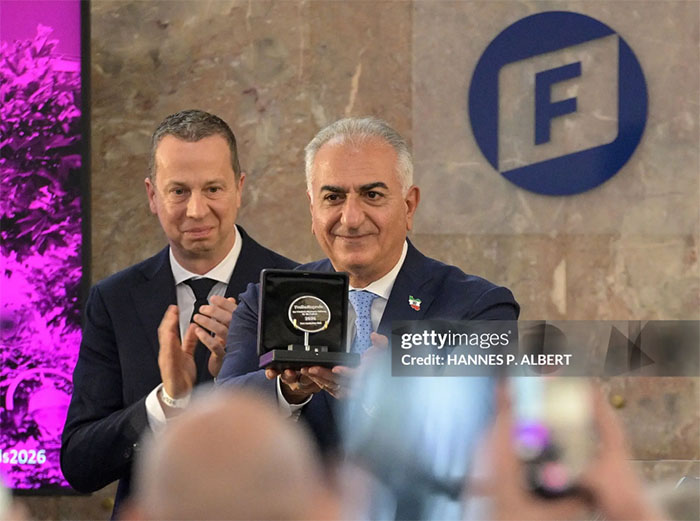
Reza Pahlavi Receives 2026 Freedom Prize in Frankfurt as Thousands of Demonstrate in Germany
The Lion and Sun emblem has a long history in Iranian political and cultural identity.
Before the 1979 Iranian Revolution, the symbol appeared on Iran’s national flag alongside the country’s traditional colours. Following the establishment of the Islamic Republic, the national flag was redesigned and the Lion and Sun emblem was removed.
Since then, the historic symbol has continued to appear at demonstrations organised by various Iranian opposition movements, particularly among monarchists and supporters of Reza Pahlavi.
During the Frankfurt gathering, demonstrators displayed the pre-revolutionary flag as an expression of their political identity and their vision for Iran’s future.
For some participants, the emblem represents the memory of Iran before the Islamic Revolution. For others, it is primarily a national symbol that they associate with Iranian history rather than a definitive endorsement of restoring the monarchy.
The appearance of the Lion and Sun flag at European demonstrations therefore reflects a broader discussion about Iranian identity, political legitimacy and the relationship between historical symbols and contemporary democratic aspirations.
Reza Pahlavi and the Debate Over Iran’s Political Future
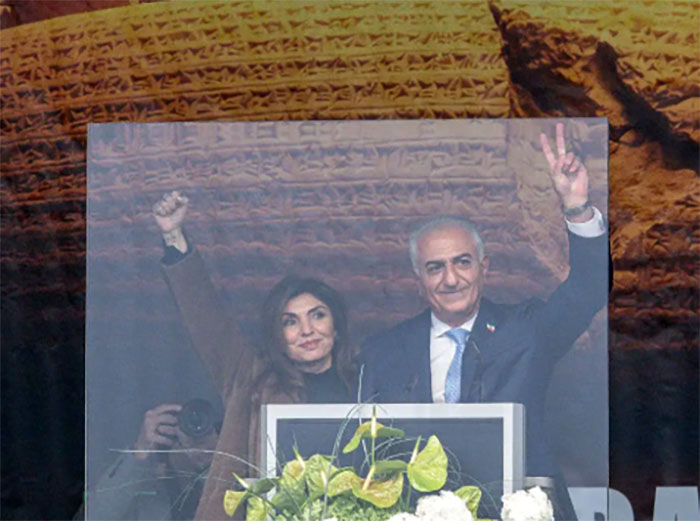
The Frankfurt ceremony brought renewed attention to Reza Pahlavi’s political ambitions and his proposed role in a potential transition in Iran.
As the son of Mohammad Reza Pahlavi, the last Shah of Iran, he occupies a distinctive position in the country’s modern political history.
His father was removed from power during the 1979 Islamic Revolution, which fundamentally transformed Iran’s political institutions and international relationships.
Reza Pahlavi subsequently lived in exile and became increasingly associated with opposition activities abroad.
Over the years, he has advocated political change and presented himself as a potential transitional figure if the Islamic Republic were to collapse.
His supporters argue that his international visibility could help bring together different opposition groups and attract international attention to the situation in Iran.
They also point to his public statements supporting a future in which the Iranian people determine their own political system.
Nevertheless, his political position remains controversial.
Critics argue that the legacy of the Pahlavi monarchy must be considered when assessing his political ambitions. The government of his father was authoritarian, and the history of political repression under the former monarchy remains significant for many Iranians.
Some opposition groups also reject monarchist political traditions and favour a republic or another democratic constitutional arrangement.
Consequently, the question of Reza Pahlavi’s role is closely connected to a wider debate: who should represent the Iranian opposition, and how should a future democratic political system be established?
The Freedom Prize ceremony did not resolve these questions. Instead, it brought them into greater international focus.
November 7, 2026 | 3:11 pm