Asghar Farhadi’s “Parallel Tales” Arrives at Cannes: A Red Carpet Defined by Cinema, Elegance, and Global Anticipation
Isabelle Huppert and the Power of Presence
If Asghar Farhadi’s name guaranteed artistic seriousness, Isabelle Huppert’s participation elevated anticipation even further.
Few actresses in contemporary cinema possess a reputation as commanding as Huppert’s. Over several decades, she has become synonymous with fearless performance. Her filmography spans arthouse masterpieces, psychological dramas, literary adaptations, and experimental works that challenge audiences intellectually and emotionally.
Huppert’s acting style is uniquely difficult to categorize.
She often performs with extraordinary restraint, yet beneath that restraint exists emotional volatility. Her characters frequently conceal intense internal worlds beneath calm surfaces. This quality aligns remarkably well with Farhadi’s storytelling approach.
Both artist and actress specialize in emotional ambiguity.
Neither relies on obvious sentimentality.
Instead, they trust silence, tension, hesitation, and contradiction.
The prospect of their collaboration therefore fascinated cinephiles long before the Cannes premiere.
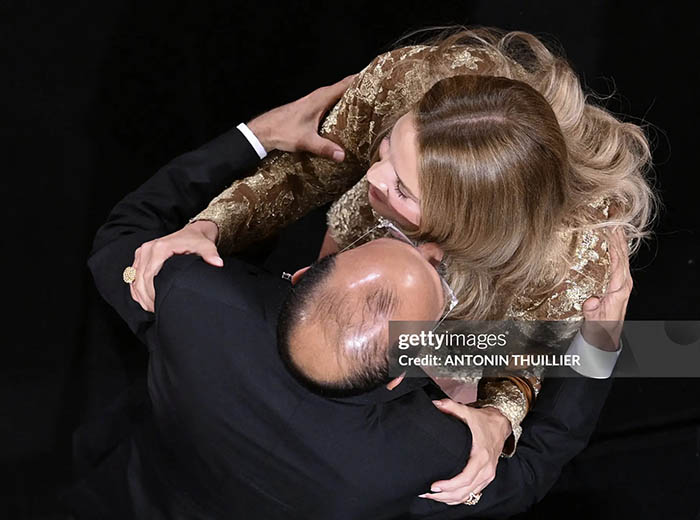
When Huppert arrived at the Palais des Festivals alongside Farhadi, photographers immediately recognized the symbolic significance of the moment.
The images captured during the evening reflected not merely celebrity glamour, but artistic alliance.
Dressed with characteristic elegance, Huppert embodied the sophisticated restraint associated with French cinema. Her presence on the carpet felt timeless rather than trend-driven. She carried herself with the confidence of an artist deeply familiar with Cannes history and international cinema culture.
Huppert’s relationship with Cannes stretches across decades.
She has appeared at the festival numerous times throughout her career, becoming one of its defining recurring figures. Her film premieres at Cannes often generate critical discussion because audiences understand the seriousness of projects she chooses.
That reputation intensified curiosity surrounding “Parallel Tales.”
Observers speculated about the nature of her role in the film. Would she portray a morally conflicted figure typical of Farhadi’s storytelling universe? Would the narrative center on family tension, political context, psychological isolation, or interpersonal deception?
The secrecy surrounding the project amplified the power of the red carpet imagery.
Every photograph of Huppert beside Farhadi seemed to promise a cinematic experience rooted in emotional complexity.
At Cannes, visual symbolism matters enormously.
The image of an acclaimed Iranian auteur standing beside one of France’s greatest actresses communicated the international spirit of contemporary cinema. It suggested collaboration beyond national boundaries.
It also reminded audiences that Cannes remains one of the few spaces where artistic cinema still receives the same ceremonial treatment often reserved for major commercial franchises.
The applause greeting Huppert’s arrival reflected deep respect.
For younger actors attending the festival, her presence represented continuity with generations of European cinema history. For critics and scholars, it symbolized artistic credibility. For photographers, it provided one of the defining visual moments of the evening.
And for audiences awaiting “Parallel Tales,” it intensified excitement surrounding the film’s emotional and intellectual possibilities.
May 14, 2026 | 6:34 pm