Asghar Farhadi’s “Parallel Tales” Arrives at Cannes: A Red Carpet Defined by Cinema, Elegance, and Global Anticipation
The Cannes Film Festival as a Global Stage
To understand the scale of excitement surrounding “Parallel Tales,” it is necessary to understand the role Cannes plays in international cinema.
The Cannes Film Festival has long existed as more than a celebration of movies. It is a meeting point between art and mythology. Every May, filmmakers, actors, critics, producers, distributors, journalists, and cinephiles travel to the French Riviera not only to watch films, but to witness cinema history unfolding in real time.
The Palais des Festivals, standing beside the Mediterranean coast, becomes an arena where careers are transformed overnight. A successful Cannes premiere can elevate unknown actors into international stars. It can redefine a director’s reputation. It can trigger global distribution deals, awards campaigns, and years of scholarly discussion.
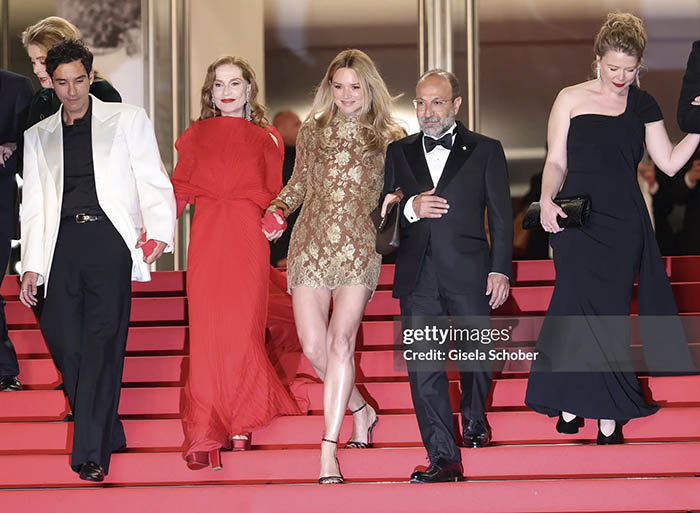
The red carpet itself has become one of the most recognizable visual rituals in contemporary culture.
The staircase leading into the Grand Théâtre Lumière possesses symbolic power unlike almost any other cinematic location in the world. Actors ascending the steps become part of a historical continuum that stretches across generations of filmmakers and performers. Every photograph taken on those stairs enters an archive connected to decades of cinema history.
For auteurs such as Asghar Farhadi, Cannes also represents artistic validation.
Unlike commercial premieres designed purely around box office anticipation, Cannes screenings frequently frame films within broader cultural conversations. Directors arrive not only as entertainers but as artists presenting works to a global community of critics, scholars, and cinephiles.
Farhadi’s relationship with international festivals has always reflected this dynamic. His films are often discussed not merely as narratives, but as moral investigations. They encourage audiences to examine ambiguity rather than seek simplistic answers.
That complexity aligns naturally with the spirit of Cannes.
The 2026 edition of the festival already carried significant energy before “Parallel Tales” premiered. Industry observers described the lineup as one of the strongest in recent years, with filmmakers from across Europe, Asia, Latin America, and the Middle East bringing ambitious projects to the Croisette.
Yet despite the breadth of competition, Farhadi’s film quickly emerged as a centerpiece of festival conversation.
The reason was not solely his reputation.
It was also the mystery surrounding the film itself.
Before Cannes, details about “Parallel Tales” remained relatively limited. That secrecy intensified public curiosity. Festival attendees arrived eager to discover how Farhadi would evolve his cinematic language, particularly in collaboration with French performers and within a more overtly European setting.
The red carpet therefore became more than a glamorous arrival sequence.
It became the opening chapter of an artistic unveiling.
May 14, 2026 | 6:34 pm