Asghar Farhadi’s “Parallel Tales” Arrives at Cannes: A Red Carpet Defined by Cinema, Elegance, and Global Anticipation
The Red Carpet Atmosphere
The Cannes red carpet possesses its own rhythm.
Hours before a major premiere begins, crowds gather behind barriers stretching along the Croisette. Journalists position themselves strategically near arrival points. Camera operators test equipment repeatedly. Publicists coordinate timing with near-military precision.
As sunset approaches, anticipation builds gradually.
Then the first arrivals begin.
Luxury vehicles move slowly toward the Palais des Festivals while photographers shout names in multiple languages. Security teams navigate pathways through dense clusters of media personnel. Fans raise phones above crowds hoping to capture a glimpse of actors emerging from black cars.
On the night of “Parallel Tales,” that familiar Cannes rhythm carried unusual intensity.
Farhadi’s arrival drew not only entertainment media but also major international cultural journalists. The premiere appealed simultaneously to fashion publications, film critics, political commentators, and arthouse cinema enthusiasts.
This blend of audiences reflected Farhadi’s broad cultural influence.
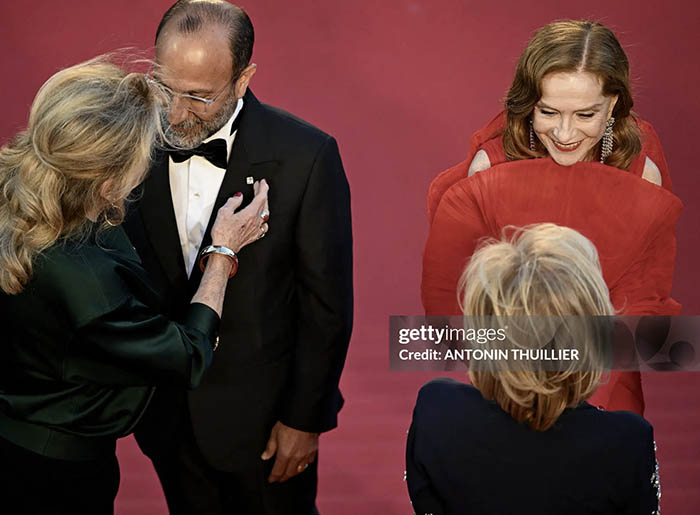
When Isabelle Huppert stepped onto the carpet, flashes exploded instantly across the staircase area. Her appearance alongside Farhadi created one of the evening’s most visually striking pairings.
The atmosphere balanced glamour with seriousness.
Unlike highly commercial premieres where screaming fans dominate the environment, the “Parallel Tales” screening generated a mood of concentrated attention. Conversations among attendees frequently centered on cinema itself: Farhadi’s previous films, Huppert’s performances, awards speculation, and the role of international storytelling in contemporary culture.
That intellectual energy distinguished the event.
Additional arrivals amplified the sense of prestige.
Vincent Cassel’s appearance brought another major French cinematic figure into the spotlight. Known for his intense screen presence and eclectic career, Cassel added a layer of contemporary star power to the gathering.
Meanwhile, Catherine Deneuve’s arrival carried immense symbolic weight.
Deneuve remains one of the most legendary figures in French cinema history. Her presence on the carpet connected “Parallel Tales” to decades of artistic tradition associated with Cannes itself.
As photographers captured images of Deneuve standing alongside Huppert and Farhadi, the moment seemed to represent a meeting of cinematic eras.
India Hair also drew attention during the evening, contributing to the film’s strong ensemble presence.
Throughout the arrivals, Cannes demonstrated its remarkable ability to merge glamour with cultural significance.
Fashion remained central to visual coverage, of course. Elegant tailoring, couture gowns, jewelry, and styling all contributed to the spectacle.
Yet unlike many celebrity events focused entirely on appearance, the “Parallel Tales” premiere retained an unmistakable connection to artistic conversation.
Observers discussed narrative themes, directorial style, and cinematic history almost as much as clothing.
That balance is increasingly rare within modern entertainment culture.
The staircase ascent itself became one of the evening’s defining sequences.
Farhadi walked with calm composure while greeting photographers and festival guests. Huppert maintained her characteristic elegance and poise. Together, they embodied a premiere grounded in artistic credibility rather than pure publicity.
As attendees entered the Palais des Festivals for the screening, the atmosphere inside shifted from spectacle to anticipation.
The red carpet had completed its function.
Now audiences would finally encounter the film itself.
May 14, 2026 | 6:34 pm