10 Fascinating Stories About Most Famous Actresses: Behind-the-Scenes Secrets From Iconic Films and TV Shows
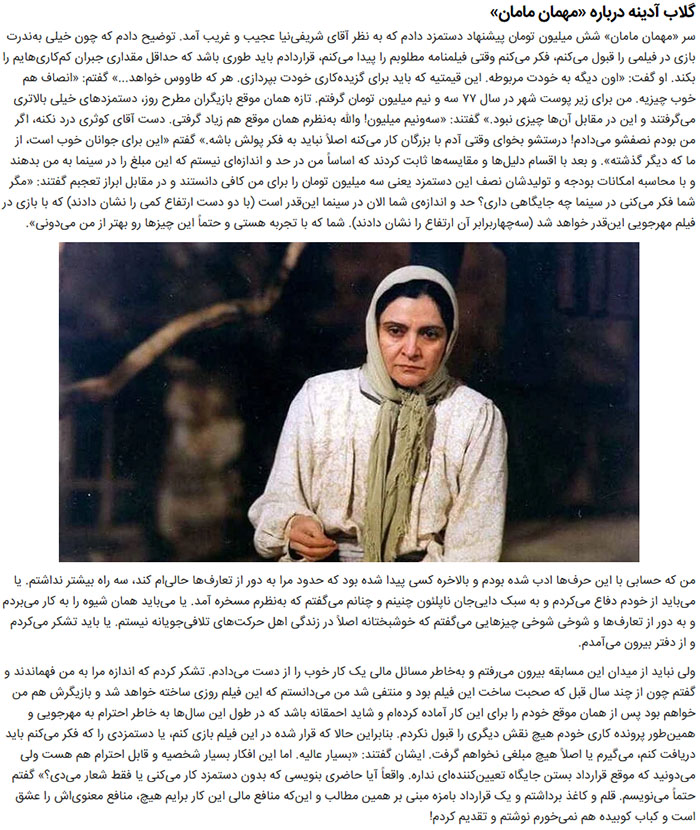
5. Golab Adineh and Mehman-e Maman: The Salary Negotiation That Became an Unforgettable Story
Film: Mehman-e Maman (Mom’s Guest)
Director: Dariush Mehrjui
Some of the most revealing stories about the film industry have little to do with cameras or acting techniques. They concern money, professional recognition, and the negotiations that determine who gets hired and under what conditions.
Golab Adineh’s account of negotiating her fee for Mehman-e Maman, directed by Dariush Mehrjui, is one such story.
The anecdote is unusually detailed. It describes an exchange in which the actress requested a fee she considered appropriate, only to encounter arguments about her perceived market value and the supposed benefits she would receive from appearing in the film.
The discussion became a memorable example of the tension between artistic commitment and professional compensation.
Why Adineh Asked for Six Million Tomans
Adineh explained that she had requested a fee of six million tomans for her role in Mehman-e Maman.
The amount reportedly surprised Mohammad Sharifinia, who was involved in the production discussions.
Adineh’s explanation was straightforward: she accepted film roles selectively. When she finally found a script she genuinely wanted to perform, she believed the contract should reflect not only the work itself but also the long periods during which she declined other opportunities.
This reasoning raises an important issue in acting and other freelance professions.
An individual’s fee is not always a simple calculation of the number of days spent working. It can also reflect experience, availability, reputation, opportunity costs, and the value of the particular project.
For an actor who rejects numerous roles, accepting a new film may mean giving up other paid work or waiting for a project that meets specific artistic standards.
From Adineh’s perspective, her selectivity was part of her professional identity, not a reason to reduce her compensation.
The Disagreement Over Her Market Value
According to Adineh’s account, the discussion turned toward her previous work and the amount she had received for Under the Skin of the City.
She recalled receiving 3.5 million tomans for that film in 1998, while noting that prominent actors at the time were earning considerably more.
The production representatives reportedly argued that the earlier fee had already been generous and suggested that her professional standing did not justify the amount she was requesting.
The conversation then shifted toward the claim that working with a major director such as Mehrjui would enhance her standing in Iranian cinema.
In effect, the argument presented the project itself as a form of compensation: appearing in an important film would increase her artistic reputation, so she should accept less money.
This is a familiar tension in creative industries.
Actors, musicians, designers, writers, and other professionals may be told that the prestige of a project makes financial compensation less important.
Sometimes, a project genuinely offers career benefits that justify accepting a lower fee. At other times, the promise of future recognition can become a way of shifting financial risk onto the individual worker.
Adineh’s account illustrates how difficult it can be to balance these considerations.
“What Is Your Standing in Cinema?”
One of the most striking parts of the story concerns the way Adineh recalled being told that her stature in cinema was relatively small and would increase after appearing in a Mehrjui film.
The representatives reportedly used a physical gesture to illustrate their assessment of her current professional position, then indicated a much greater height to represent where it might stand afterward.
The implication was that the role would substantially improve her status.
For Adineh, the discussion felt like an attempt to define her worth on someone else’s terms.
Her recollection conveys the frustration of being told that one’s experience, professional judgment, and previous work are insufficient to justify the fee one believes is appropriate.
It also raises a wider question: who gets to determine an artist’s value?
In commercial terms, producers may consider budgets, expected audiences, financing arrangements, and the financial risk associated with a film.
An actor, however, may consider years of experience, the difficulty of the role, previous earnings, and the artistic importance of the project.
Neither perspective automatically settles the negotiation.
A successful contract requires the parties to reach an agreement rather than assuming that one side’s assessment of the artist’s standing should determine the outcome.
Why Adineh Refused to Walk Away
Despite the disagreement, Adineh did not want to abandon the project.
She explained that the film had been discussed years earlier and that she had believed she would eventually appear in it.
According to her recollection, she had been preparing herself for the opportunity and had declined other roles partly out of respect for Mehrjui and her commitment to the project.
This is an important detail because it reveals that her decision was not purely financial.
The film represented an artistic opportunity she valued deeply.
Her challenge was to defend her professional position without losing the role she had anticipated for so long.
That situation is familiar to many people working in creative fields. A project can be financially important, personally meaningful, and professionally prestigious at the same time.
Negotiating effectively requires an individual to recognize all three dimensions without allowing one to erase the others.
The Unexpected Contract
Adineh eventually proposed an extraordinary solution.
She reportedly told the production team that she would either receive the fee she considered appropriate or work without payment.
When the representatives questioned whether she was serious, she agreed to put the proposal in writing.
She then drafted a humorous document stating that she sought no financial gain and that artistic fulfillment was what mattered most. She even added that she would not eat kabab koobideh during the production.
The detail about the food gives the story its comic conclusion.
It transforms an uncomfortable negotiation into an anecdote about the absurdity of reducing artistic commitment to a financial calculation.
The document was not simply a declaration that money did not matter. Within the context of Adineh’s story, it exposed the contradiction in the argument that her enthusiasm for the project should make compensation irrelevant.
If artistic fulfillment was truly sufficient, the parties could accept her proposed arrangement. If it was not, they would have to negotiate the financial terms more seriously.
The anecdote does not establish the complete contractual history of the production, but it vividly captures the tension Adineh remembered.
The Broader Lesson About Artists and Compensation
Creative professionals are often expected to balance passion with financial reality.
A role in a respected film may provide artistic satisfaction, professional recognition, and opportunities for future work. These benefits can be valuable, but they do not automatically pay rent or replace income lost by rejecting other projects.
The same issue appears in industries far beyond cinema. Freelancers may be offered exposure instead of payment, while experienced professionals are sometimes asked to accept less because a project is described as an honor.
Adineh’s story demonstrates the importance of knowing one’s own priorities.
For her, the project had significant artistic meaning. That did not necessarily mean she believed the work should be undervalued.
Her response also shows how humor can expose an uncomfortable situation without turning it into a purely hostile confrontation.
Why Mehman-e Maman Matters in the Story
Mehman-e Maman is associated with the work of Dariush Mehrjui, one of the influential directors of Iranian cinema.
The film’s significance to Adineh is central to her recollection: she wanted to be part of a project that she had anticipated for years.
That desire explains why she continued the negotiation despite feeling that her professional value was being questioned.
The story therefore reveals two sides of an actor’s career. On one side is the practical business of fees, contracts, and budgets. On the other is the artistic desire to participate in a project that feels worthwhile.
October 16, 2026 | 6:53 pm