10 Fascinating Stories About Most Famous Actresses: Behind-the-Scenes Secrets From Iconic Films and TV Shows
6. Niki Karimi and Farimah Farjami: A Journey to America and a Memory of Kindness
Actress remembered: Farimah Farjami
Other filmmaker mentioned: Tahmineh Milani
Some of the most moving stories about the film industry are not about arguments, accidents, or dramatic performances. They are about the people who make a lasting impression through their kindness.
Niki Karimi’s recollections of the late actress Farimah Farjami offer a particularly warm example.
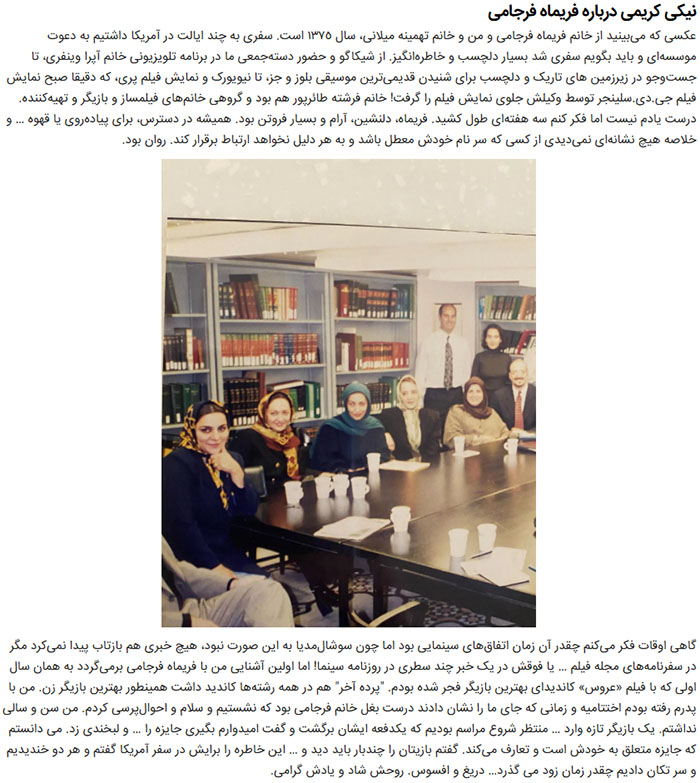
Karimi described a trip to the United States in 1996 that brought together a group of Iranian female filmmakers, actresses, and producers. The journey included a visit to Chicago, where the group reportedly appeared on The Oprah Winfrey Show, excursions to New York, and a screening connected with the Iranian film Pari.
The trip provided opportunities for professional exchange and cultural exploration at a time when international visibility for Iranian women in cinema was developing in different ways.
For Karimi, however, one of the most memorable aspects was Farjami herself.
A Journey Filled With Unusual Experiences
According to Karimi’s account, the trip lasted approximately three weeks, although she did not recall its exact duration.
The group traveled to several American states and experienced a variety of cultural activities.
One particularly memorable episode involved exploring dimly lit basements in search of old blues and jazz music.
The image is striking: Iranian actresses and filmmakers, known to audiences through Persian-language cinema, discovering another musical tradition in informal spaces far from home.
Such experiences can be important for artists because they offer opportunities to encounter unfamiliar creative environments.
A filmmaker who watches a performance in a small music venue may notice something different from what they would learn in a formal classroom or industry meeting.
Likewise, a group of actresses traveling together can exchange ideas about acting, production, and professional opportunities in ways that might be difficult during a normal working day.
The Screening of Pari
Karimi also remembered traveling to New York for a screening of Pari.
According to her recollection, the screening encountered an unexpected legal obstacle involving a lawyer representing the American author J. D. Salinger.
The precise legal circumstances should be checked against contemporary reporting before being presented as a fully established account. Nevertheless, the anecdote conveys how international screenings could be affected by legal questions surrounding literary adaptations and film rights.
For Iranian filmmakers seeking to show their work abroad, screenings were not simply artistic events. They could also involve negotiations over distribution, permissions, translation, and intellectual property.
The experience reminds readers that the international circulation of films depends on a complex network of artistic and legal arrangements.
What Made Farimah Farjami So Memorable?
Karimi’s description of Farjami focuses on her personality rather than her fame.
She remembered her as charming, calm, humble, and easy to approach. Farjami was reportedly willing to go for a walk or have a cup of coffee and did not behave as though her reputation placed her above other people.
Karimi’s recollection is affectionate because it emphasizes ordinary gestures.
The willingness to spend time with colleagues, listen to them, and participate in everyday activities can be more memorable than grand displays of generosity.
In professional environments, where competition and recognition can create distance between people, a lack of pretension can make a lasting impression.
The anecdote suggests that Farjami’s character was part of what made her admired by those who knew her.
Their First Meeting at the Fajr Film Festival
Karimi also recalled meeting Farjami earlier in her career, at the Fajr Film Festival.
Karimi had been nominated for Best Actress for her role in The Bride, known in Persian as Aroos. The Last Act, or Pardeh-ye Akhar, was also nominated in multiple categories, including Best Actress.
Karimi attended the ceremony with her father and found herself seated beside Farjami.
She remembered being young and relatively new to the industry.
Before the ceremony began, Farjami reportedly turned to her and expressed the hope that Karimi would win the award.
Karimi interpreted the comment as a kind gesture. In her view, Farjami’s own performance was especially deserving of recognition.
Karimi replied by praising Farjami’s work, suggesting that it was the kind of performance that deserved to be watched multiple times.
The exchange became a memory Karimi later shared with Farjami during their trip to America.
According to Karimi, they laughed together while recalling how much time had passed.
The Meaning of a Small Act of Encouragement
The story illustrates the influence that a few words can have on someone beginning a career.
Awards ceremonies are often presented as competitions, with attention focused on winners and losers. Yet the experience of being recognized or encouraged by a respected colleague can be equally meaningful.
For a young actor, a sincere expression of support from an established performer may help create a sense of belonging in an unfamiliar industry.
Farjami’s reported comment was simple, but Karimi remembered it years later.
This is one of the reasons personal anecdotes can offer insights that formal film criticism cannot. They reveal how professional relationships are shaped by small interactions that may never appear in a film’s credits.
Iranian Women in Cinema Before Social Media
Karimi reflected on how many important events in Iranian cinema took place before social media made it easy to share photographs, videos, and personal accounts instantly.
Today, a short video from a festival or an international screening can reach thousands of viewers within minutes.
In the 1990s, similar experiences might receive only limited coverage in specialist magazines or short newspaper reports.
As a result, many interesting stories from the history of Iranian cinema remain accessible primarily through interviews and personal recollections.
These accounts are valuable because they preserve the informal dimensions of cultural history: the journeys, conversations, friendships, and unexpected encounters that do not necessarily appear in official records.
Remembering Farimah Farjami
Karimi’s account is ultimately a tribute to Farjami’s warmth and humility.
It reminds readers that the legacy of an actress is not defined only by her filmography or awards. It is also shaped by the memories she leaves with colleagues and friends.
For people interested in Iranian actresses and the history of Persian cinema, the story offers a glimpse of a professional community built through artistic collaboration and personal relationships.
October 16, 2026 | 6:53 pm