Women Without Hijab: The Propaganda Paradox of Daily Life in Tehran During War
Tehran as a Visual Contradiction
Tehran is particularly revealing because it contains multiple versions of Iranian society simultaneously.
The city is home to government institutions, religious centers, universities, businesses, shopping districts, traditional neighborhoods, modern cafés and large public spaces.
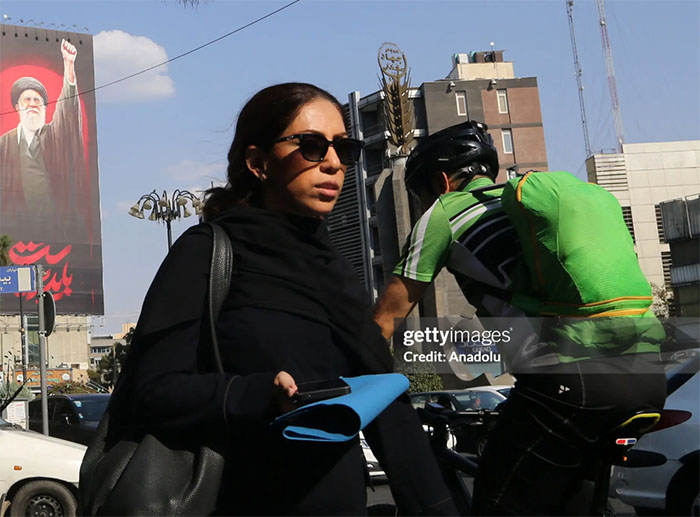
Political billboards can stand only meters away from people engaged in completely ordinary activities.
A giant anti-American message can dominate a public square while pedestrians walk beneath it without visibly engaging with the message.
A portrait of a political leader can occupy an entire wall while commuters continue with their daily routines.
This coexistence creates a visual contradiction.
The state communicates from above.
Society responds from below.
The two do not necessarily operate according to the same logic.
The Meaning of a Woman Walking Without Hijab
Consider a simple photograph.
An Iranian woman walks along a Tehran street.
She is not holding a sign.
She is not speaking to journalists.
She is not protesting.
She is simply walking.
If the photograph is taken during a period of political tension, however, the image can acquire additional meaning.
International audiences may interpret it as evidence of resistance.
Government supporters may interpret it as evidence of declining religious observance.
Human-rights organizations may interpret it as evidence of changing enforcement.
A local observer may simply see an ordinary woman going about her day.
All four interpretations can coexist.
The photograph itself cannot tell us what the woman believes.
That is why responsible reporting should distinguish between what an image shows and what observers infer from it.
September 14, 2026 | 6:05 pm