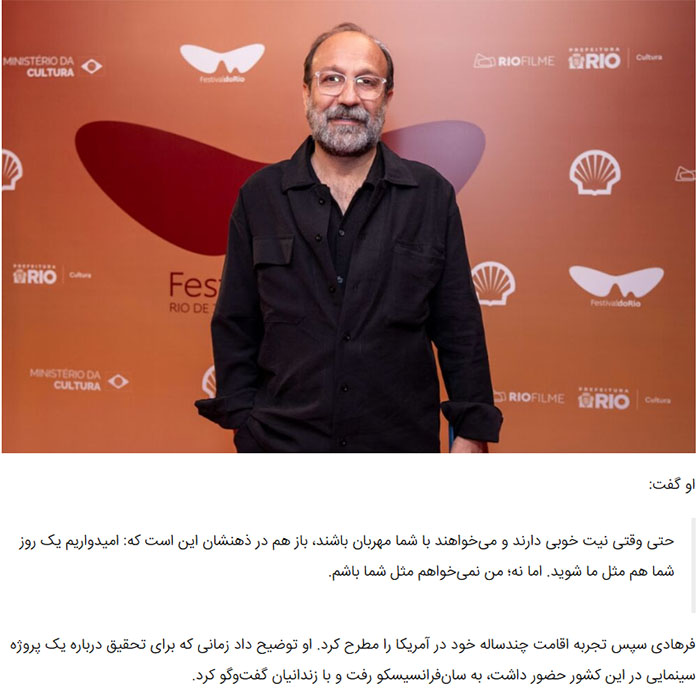
Asghar Farhadi, Hollywood and the Politics of Cinema
The “American Savior” Narrative in Hollywood
Another important element of Farhadi’s comments concerns what can be described as the American savior narrative.
In some Hollywood stories, an American protagonist enters another country, confronts a crisis and ultimately becomes the person capable of resolving the situation.
This storytelling structure can be effective dramatically.
It gives audiences a recognizable protagonist and creates a clear narrative of danger, courage and rescue.
However, critics of this approach argue that it can unintentionally imply that local populations are incapable of solving their own problems.
Farhadi challenged precisely this assumption when discussing movies in which an American travels to countries such as Iran or Cuba to save people.
His question was essentially:
Why must the outsider be the hero?
This is a broader issue in international cinema.
Representation versus storytelling
A filmmaker naturally has the right to construct a story around a particular protagonist.
The problem arises when repeated storytelling patterns become associated with entire cultures.
If audiences repeatedly encounter stories in which:
- Americans are the rescuers,
- foreigners are victims,
- local institutions are corrupt or incompetent,
- Western intervention produces the solution,
then those patterns can influence cultural perceptions.
This is why discussions about Hollywood stereotypes, American cinema and foreign countries, and representation of Iran in Hollywood movies continue to attract academic and public interest.
October 5, 2026 | 7:22 pm