Asghar Farhadi, Hollywood and the Politics of Cinema
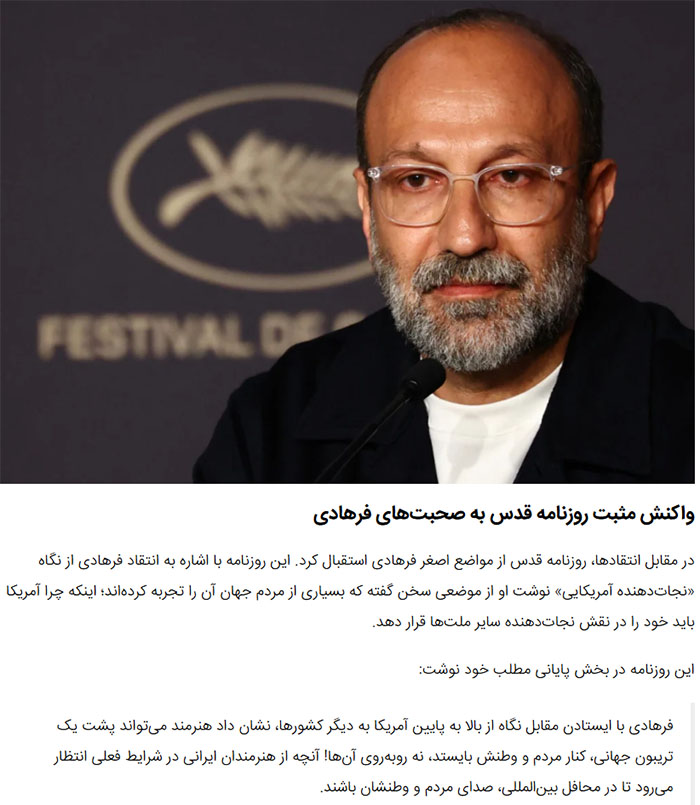
Final Analysis: Asghar Farhadi’s Controversial Remarks
Asghar Farhadi’s comments about Hollywood, Argo and American democracy have generated controversy because they touch several sensitive issues simultaneously.
They concern American exceptionalism, Hollywood representation, Iranian cinema, political filmmaking, cultural power, democracy and the complicated relationship between artists and international institutions.
His critics see contradictions between his criticism of American cultural power and his long-standing relationship with the international film industry.
His supporters see an internationally recognized Iranian artist using a global platform to challenge assumptions about American superiority and the role of Hollywood in representing other societies.
Neither interpretation fully resolves the debate.
Farhadi’s own filmmaking suggests that reality is rarely that simple.
His best-known films do not divide the world into perfect heroes and absolute villains. Instead, they examine how ordinary people become trapped in complicated circumstances.
The same complexity applies to the debate surrounding his remarks.
Hollywood can produce stereotypes, but it can also produce deeply critical and culturally sophisticated films.
The United States can possess powerful democratic institutions while facing serious democratic and social problems.
Iran can possess a remarkable artistic culture while simultaneously being the subject of intense political debate.
Farhadi can criticize American institutions while continuing to participate in international cinema.
These apparent contradictions are not necessarily evidence that one side is entirely dishonest.
They may simply reflect the complicated nature of contemporary global culture.
The most valuable outcome of Farhadi’s comments may therefore be the debate itself.
His remarks force audiences to ask who controls international narratives, how cinema shapes political perceptions, whether Hollywood represents other countries fairly, what democracy really means, and whether artists have a responsibility to challenge the assumptions of powerful cultural institutions.
For a filmmaker whose work has consistently explored ambiguity, uncertainty and conflicting perspectives, that may be the most Farhadian aspect of the entire controversy.
Asghar Farhadi’s comments on Hollywood, Argo and American democracy have opened a new chapter in the long-running conversation about Iranian cinema and the global power of film. The debate is likely to continue because the questions behind it extend far beyond one director or one movie. They concern how nations see one another, how stories become political, and how cinema can shape the way millions of people understand the world.