Asghar Farhadi, Hollywood and the Politics of Cinema
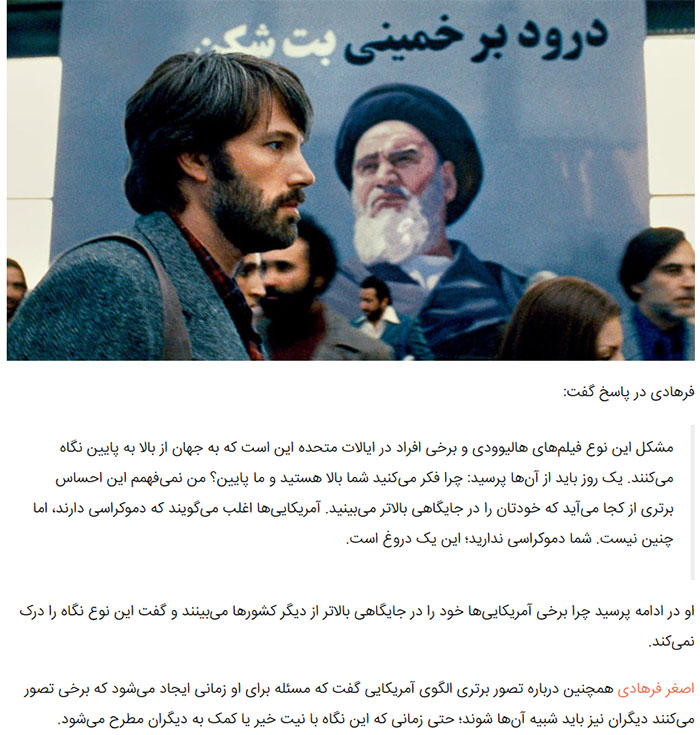
Asghar Farhadi and Argo: Why the Film Remains Controversial
One of the central subjects in Farhadi’s discussion was Ben Affleck’s Argo.
Released in 2012, Argo dramatizes the 1979 Iran hostage crisis and a CIA-supported operation to rescue six American diplomats who escaped the U.S. Embassy in Tehran.
The film became a major commercial and critical success and won the Academy Award for Best Picture at the 2013 Oscars.
Its success also placed it in an interesting historical relationship with Farhadi’s career.
Only one year earlier, A Separation had won the Academy Award for Best Foreign Language Film, making Farhadi one of the most prominent representatives of Iranian cinema in Hollywood’s international awards system.
The contrasting portrayals of Iran became an important part of the cultural conversation.
While A Separation focuses primarily on relationships, family conflict, morality and social pressures, Argo uses Iran as the setting for a political thriller based on a historical crisis.
For Farhadi, the issue is not simply whether Argo is entertaining or technically successful.
His criticism concerns the broader question of who gets to tell a country’s story and from whose perspective that story is presented.
How Hollywood portrays Iran
Hollywood has produced numerous films involving Iran, the Middle East and American foreign relations.
These movies can reach enormous international audiences. Consequently, they may influence perceptions of countries and societies that many viewers have never visited.
Farhadi’s criticism reflects a longstanding argument in international cinema: American movies are often distributed on a much larger global scale than films produced in smaller national industries.
This creates an imbalance in cultural representation.
A Hollywood production can become a worldwide cultural reference point, while an Iranian, Egyptian, Indian, Brazilian or African film may reach only a fraction of the same audience.
This does not necessarily mean that every Hollywood film presents an inaccurate image of another country.
However, it raises an important question:
Who controls the narrative when one country’s film industry has vastly greater global distribution power?
That question is at the center of the controversy surrounding Farhadi’s comments.
October 5, 2026 | 7:22 pm