Asghar Farhadi, Hollywood and the Politics of Cinema
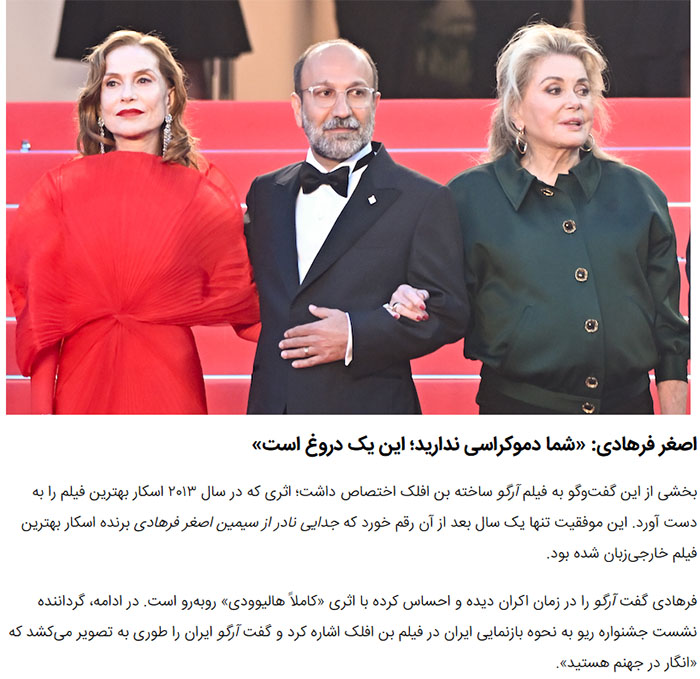
The controversy surrounding Asghar Farhadi’s latest comments goes far beyond a single statement about the United States. His remarks have reopened a much larger discussion about Iranian cinema, Hollywood, political filmmaking, cultural representation, American foreign policy, and the role of internationally acclaimed filmmakers in political debates.
Farhadi is not an ordinary Iranian filmmaker. He is one of the most internationally recognized directors associated with contemporary Iranian cinema and one of the few Iranian filmmakers to have won the Academy Award twice. His films, including A Separation and The Salesman, have established him as a major figure in world cinema.
Because of that reputation, his comments at the Rio Film Festival attracted attention well beyond the film community. His criticism of Hollywood and his claim that American democracy is a “lie” became the focus of discussion in Iranian media, while his remarks about Argo revived an old debate about how Iran is portrayed in American movies.
Why Asghar Farhadi’s comments became controversial
The controversy is partly connected to the contrast between Farhadi’s international career and his criticism of the American film industry.
Farhadi has spent considerable time outside Iran and has participated in major international film festivals and awards ceremonies. His films have been distributed internationally, reviewed by major publications and recognized by institutions such as the Academy of Motion Picture Arts and Sciences.
His criticism of Hollywood therefore carries a particular significance.
Supporters can interpret his remarks as a filmmaker’s criticism of cultural hegemony, particularly the ability of American cinema to influence how audiences around the world understand foreign countries.
Critics, however, have questioned whether Farhadi’s criticism is consistent with his own relationship with the American film industry.
This tension explains why the reaction in Iran has been divided.
Some commentators have welcomed his willingness to criticize Hollywood publicly. Others have accused him of adopting different positions depending on the political and professional circumstances surrounding his films.
The disagreement has consequently become a debate not only about Farhadi, but also about artists, political neutrality, international recognition and cultural politics.
October 5, 2026 | 7:22 pm