Sima Bina Receives the 16th Bita Prize from Stanford University
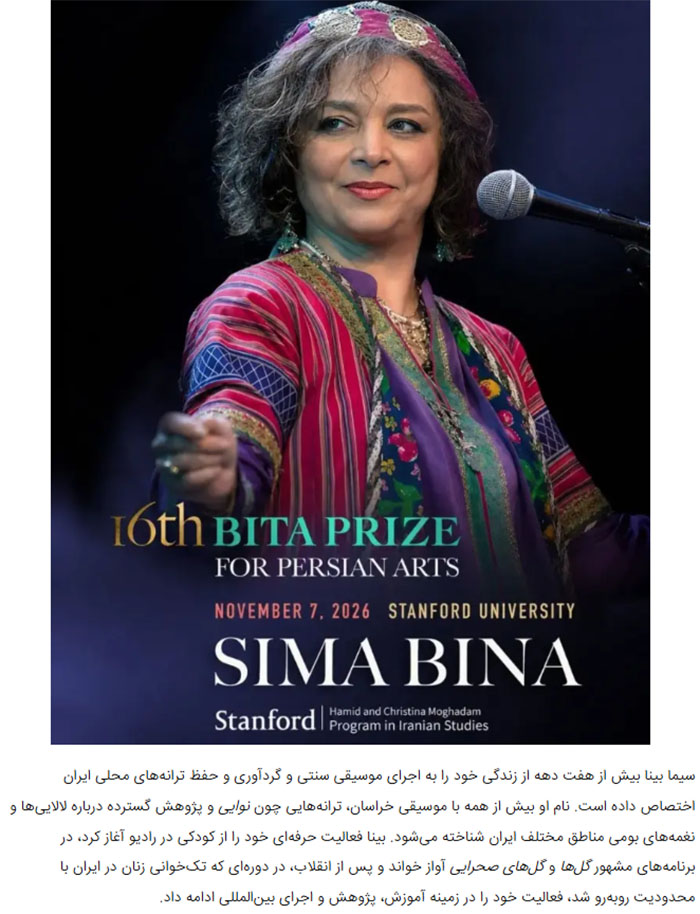
Sima Bina, the celebrated Iranian folk singer, songwriter, researcher, educator, and cultural figure, has received the 16th Bita Prize for Persian Arts from Stanford University. The award ceremony took place on Saturday, November 7, 2026, at Stanford University in California, recognizing Bina’s extraordinary contribution to Persian folk music, regional musical traditions, cultural preservation, education, and the transmission of Iranian musical heritage across generations.
The Stanford event placed Sima Bina among the major Iranian cultural figures who have been honored through the Bita Prize. Her selection is particularly significant because her career extends far beyond that of a conventional singer. For more than six decades, Bina has combined performance, musical research, teaching, cultural documentation, and artistic interpretation.
Her name has become closely associated with the folk music of Khorasan, especially the musical traditions of South Khorasan and the Birjand and Khusf areas. At the same time, her work has reached far beyond her birthplace. She has studied, performed, documented, and taught musical traditions associated with different regions and communities of Iran.
The 2026 Bita Prize therefore represents not simply recognition for a successful singer, but recognition of a lifelong cultural project: preserving musical traditions that might otherwise disappear.
Who Is Sima Bina?
Sima Bina is an Iranian singer, composer, music researcher, educator, and painter whose career has been deeply connected to the preservation of Iranian regional and folk music.
Stanford describes her as a renowned Iranian folk singer, songwriter, and researcher celebrated for preserving and promoting Persian folk music and culture. Stanford also notes that she was born in 1945 in Khorasan, Iran, began singing at an early age, and later developed a career that combined musical performance with research and education.
Unlike artists whose careers have been built primarily around commercial recordings, Bina’s importance comes from the combination of performance and cultural documentation.
She did not simply sing traditional songs.
She sought to understand where those songs came from, who performed them, how regional dialects shaped their melodies, and how musical traditions were transmitted from one generation to another.
This distinction is central to understanding her legacy.
Sima Bina became both an interpreter of Iranian folk music and one of its important cultural researchers.
November 9, 2026 | 6:01 pm