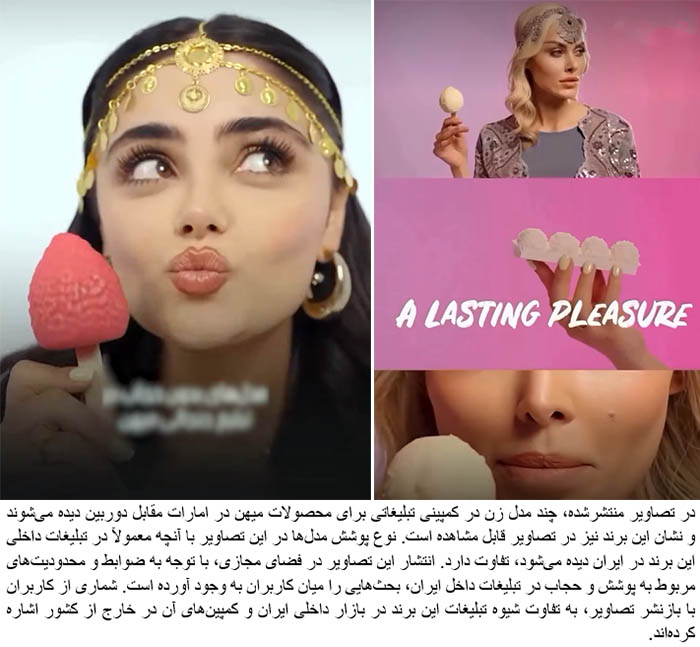
Different Images from the “Mihan” Brand Advertisement in the United Arab Emirates Become Controversial
Why Did the Mihan UAE Images Become Controversial?
The main reason for the attention appears to be the contrast between the clothing of the models in the UAE campaign and the clothing generally seen in advertisements for the brand in Iran.
Advertising in Iran operates within a specific regulatory and cultural framework. Commercial campaigns must comply with the country’s rules regarding public presentation, including requirements concerning women’s clothing and hijab. As a result, advertising photographs produced for the Iranian market typically reflect these restrictions.
The UAE campaign, by contrast, appears to have been produced for a different market and under a different advertising environment. Consequently, the visual presentation of the models is noticeably different from what Iranian audiences may be accustomed to seeing in domestic advertisements.
The images therefore quickly became material for comparison.
Users reposting the photographs have questioned why the same brand can present itself differently in two markets. Others have pointed out that international companies frequently adapt their advertising to local regulations and consumer expectations, meaning that different campaigns in different countries are not necessarily unusual.
The discussion surrounding the Mihan advertisement therefore extends beyond the photographs themselves. It also raises questions about international marketing, localization, cultural adaptation and the challenges faced by companies seeking to establish themselves outside their home market.
Mihan Advertisement in UAE vs. Iran
The comparison between Mihan’s advertising in Iran and the UAE has become one of the most discussed aspects of the images.
In Iran, advertisements involving female models generally need to comply with domestic rules governing dress and appearance. The resulting campaigns therefore tend to follow a different visual language from campaigns produced in countries where such restrictions do not apply in the same way.
The UAE campaign illustrates how a company can modify its advertising approach when targeting a foreign audience.
From a marketing perspective, this is commonly known as localization. Brands operating internationally frequently adapt advertisements according to the cultural environment, legal requirements, consumer preferences and competitive conditions of each market.
A campaign that works for one audience may not necessarily work for another.
The Mihan images circulating online have therefore prompted some users to focus on the contrast between domestic and international advertising rather than the products being promoted.
The difference is particularly noticeable because Mihan is a familiar Iranian brand. Iranian consumers have developed an understanding of the company’s visual identity through years of domestic advertising. When they encounter an overseas campaign using the same logo but a significantly different presentation, the contrast can naturally attract attention.
August 23, 2026 | 5:41 pm