Kim Jong Un Calls for Artificial Intelligence and Automation in North Korea’s Weapons Systems
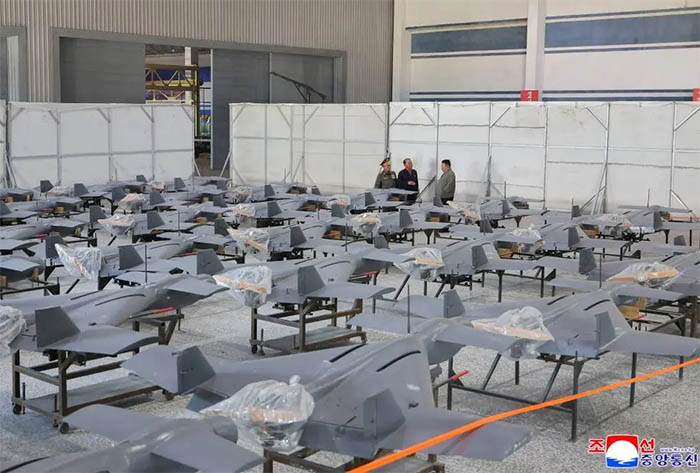
North Korea and Military Drones
Drones have become one of the most visible technologies in modern warfare.
The wars and military conflicts of recent years have demonstrated how inexpensive or relatively low-cost unmanned systems can be used alongside traditional military platforms.
North Korea has paid increasing attention to drone technology.
The country’s recent exercises have included different types of unmanned aircraft, while state media has released images showing drone production facilities.
A September 2026 exercise reportedly incorporated drones alongside ballistic missiles, cruise missiles and multiple-launch rocket systems.
This combination is significant because it suggests that North Korea is experimenting with integrated strike operations.
Rather than treating drones as a completely separate capability, North Korea may be seeking to incorporate them into broader military operations.
Drones can potentially perform different roles from missiles and artillery.
For example, an unmanned aircraft may provide surveillance or reconnaissance before or during an operation.
Another drone could serve as a decoy.
A different unmanned system could potentially conduct an attack.
When combined with missiles or rocket artillery, these systems can create a more complex operational environment.
However, publicly available information does not establish how mature North Korea’s integrated drone and missile command systems are.
The Importance of Integrated Weapons Systems
Modern warfare increasingly depends on the ability to connect different military systems.
This is sometimes described using terms such as:
network-centric warfare, multi-domain operations, integrated fires, sensor-to-shooter networks and kill chains.
The basic concept is that sensors, commanders and weapons can exchange information more rapidly.
A sensor detects an object.
The information is transmitted through a communications network.
A command system evaluates the information.
A weapon is selected.
The weapon is directed toward the relevant area.
The entire process can potentially be accelerated through automation and software.
Artificial intelligence can potentially support several steps in this process.
North Korea’s recent military exercises suggest that the country is interested in integrating different types of weapons.
The Institute for the Study of War reported that the September 12 exercise brought together short-range ballistic missiles, multiple-launch rocket systems, cruise missiles and drones.
The organization assessed that North Korea may be developing a more integrated long-range strike capability.
This does not necessarily mean that North Korea has achieved a fully networked battlefield architecture.
There are substantial technical challenges involved.
These include communications, sensors, satellite access, electronic warfare, navigation, command systems, software reliability and intelligence collection.
September 20, 2026 | 7:26 pm