Kim Jong Un Calls for Artificial Intelligence and Automation in North Korea’s Weapons Systems
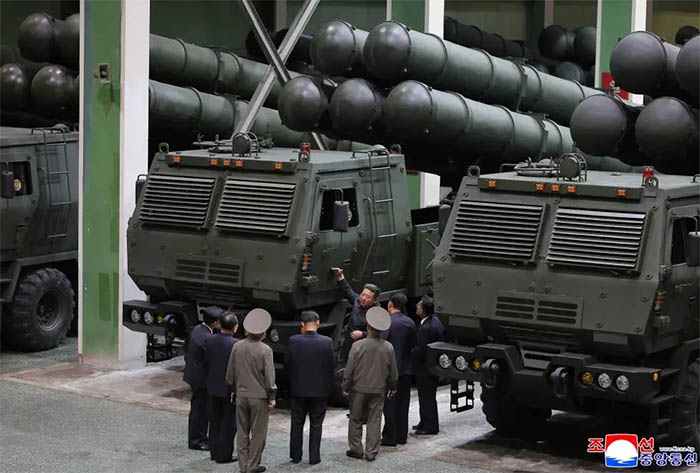
North Korea’s 600mm Multiple Rocket Launchers
Among the weapons systems associated with North Korea’s recent military modernization are its large-caliber multiple-launch rocket systems.
North Korea has displayed 600mm multiple-launch rocket systems, which have received significant international attention because of their size, mobility and reported range.
These systems are part of North Korea’s broader development of long-range conventional strike capabilities.
The 600mm systems can be understood as part of a category that sits between traditional artillery and missile systems in terms of their operational characteristics.
North Korea has repeatedly showcased these systems during military exercises and weapons demonstrations.
The September 2026 developments are particularly notable because recent North Korean exercises have combined multiple types of weapons.
The Institute for the Study of War reported that a September 12 North Korean exercise involved short-range ballistic missiles, 600mm multiple-launch rocket systems, cruise missiles and drones in a single exercise.
The organization assessed that the exercise indicated an increasing effort to integrate different weapons and platforms into a broader long-range strike complex.
Such integration is important because modern military operations increasingly involve combinations of different weapons rather than isolated systems.
A military force can potentially use missiles, drones, rocket artillery and other platforms together to complicate an opponent’s defensive response.
AI and the Future of North Korean Artillery
Kim Jong Un’s call for artificial intelligence in weapons systems raises questions about how North Korea could seek to modernize its artillery.
AI could theoretically contribute to artillery operations in several ways.
One area is target identification.
Modern military forces can use cameras, radar, infrared sensors, drones and other surveillance systems to gather information. AI-based computer vision can process large quantities of imagery and identify objects or changes in terrain.
Another area is fire-control assistance.
Computerized systems can process information relating to distance, position, weather, terrain and other variables. Automated calculations can potentially reduce the time required to prepare firing solutions.
AI can also potentially support sensor fusion, allowing information from different sources to be combined.
For example, a drone could collect imagery while another sensor detects movement. A command system could combine the information and present it to an operator.
AI could also be used in predictive maintenance.
Military equipment operates under demanding conditions. Sensors and software can monitor mechanical components and identify patterns that may indicate future failures.
In a large defense-industrial system, predictive maintenance could potentially improve equipment availability.
September 20, 2026 | 7:26 pm