Kim Jong Un Calls for Artificial Intelligence and Automation in North Korea’s Weapons Systems
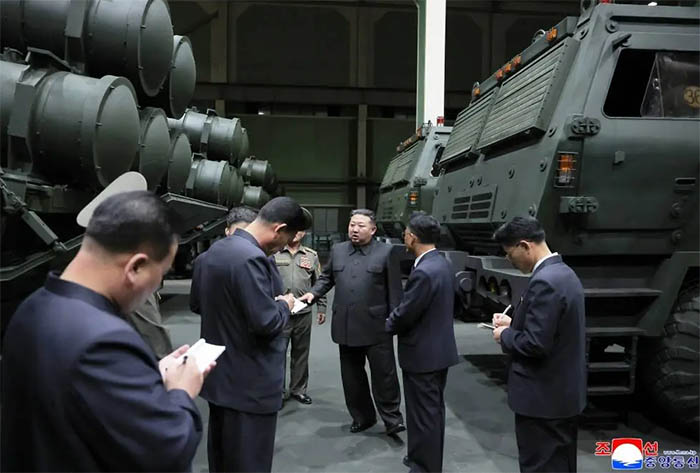
Artificial Intelligence and Autonomous Weapons
The phrase AI weapons has become increasingly common in discussions about military technology.
However, there is an important distinction between AI-assisted weapons and fully autonomous weapons.
An AI-assisted weapon might use machine learning to help classify objects or provide information to a human operator.
An autonomous system could potentially perform a larger number of functions without continuous human intervention.
The difference is important from both technological and legal perspectives.
North Korea’s recent statements call for increasing the “level” of AI in offensive and defensive combat systems, but the available reports do not establish that North Korea has deployed fully autonomous lethal weapons.
The country’s public statements should therefore not be interpreted as evidence that every AI-related weapons system is autonomous.
Instead, the available information indicates that North Korea wants AI to become a larger component of its future military technology.
Why Military AI Matters to North Korea
There are several reasons why North Korea may be interested in military AI.
One is the possibility of increasing the effectiveness of existing weapons without completely replacing them.
Software, sensors and automated control systems can potentially improve the performance of existing platforms.
Another factor is manpower.
Automation can reduce the number of personnel required for certain tasks.
This could be particularly valuable for systems that require repetitive operations.
A third factor is speed.
Modern military operations can involve enormous quantities of information.
Human operators may struggle to process every sensor input rapidly.
AI systems can potentially analyze data faster.
A fourth factor is manufacturing.
AI-powered industrial systems can potentially increase consistency and productivity.
For a country emphasizing weapons production, this could be strategically important.
Finally, AI can be used in simulation and training.
Computer systems can generate scenarios and analyze performance, potentially allowing military organizations to test different approaches without conducting every experiment in the physical world.
North Korea’s public statements do not provide enough detail to determine how extensively these capabilities are being implemented.
September 20, 2026 | 7:26 pm