Farewell to Hossein Parvaresh: The Actor, Professor, and First Fajr Film Festival Best Actor
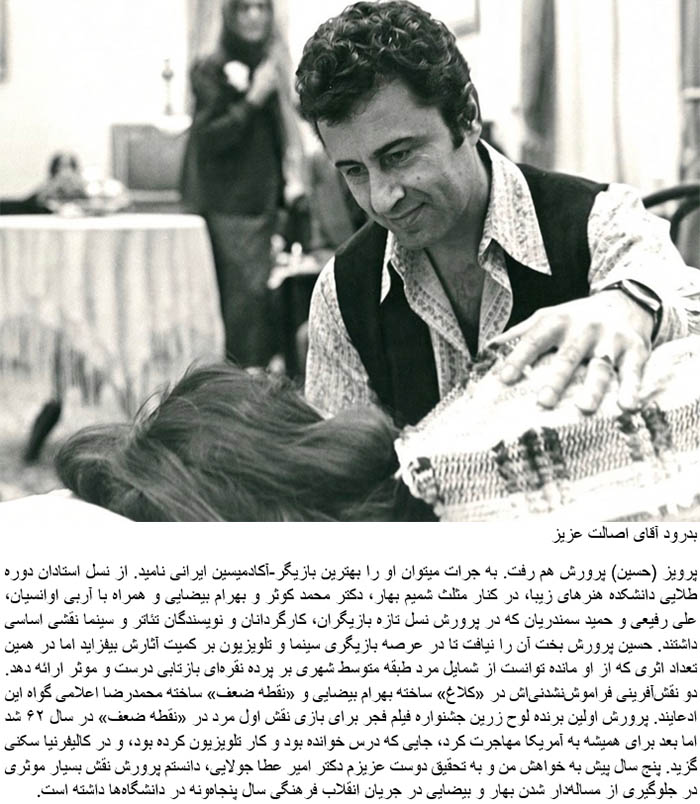
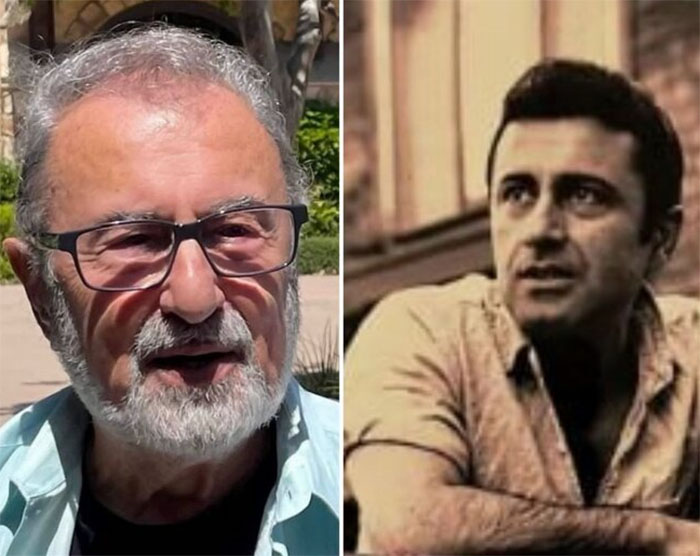
Hossein Parvaresh, also known as Parviz Parvaresh, the veteran Iranian actor, theater professor, and one of the distinctive figures associated with the golden generation of Iranian arts education, has passed away in the United States at the age of 85.
Parvaresh’s death brings renewed attention to a remarkable but relatively short cinematic career. Unlike many actors whose reputations were built through dozens of films and television productions, Hossein Parvaresh left a much smaller screen legacy. Yet the roles he did play, particularly Mr. Asalat in Bahram Beyzai’s The Crow (Kalagh) and his central performance in Mohammad Reza Ealami’s Weak Point (Noghteh Za’f), were enough to establish his name among serious students of Iranian cinema.
His career is also significant beyond acting. Parvaresh belonged to a generation of Iranian theater and cinema educators who helped shape the country’s modern performing-arts culture. He taught acting at the University of Tehran’s Faculty of Fine Arts and at the Faculty of Dramatic Arts, and he was associated with a remarkable circle of artists, writers, directors, and academics whose influence extended far beyond the stage.
His death therefore represents more than the loss of a veteran Iranian actor. It marks the passing of one of the teachers and practitioners connected to a formative period in the history of Iranian theater, cinema, and arts education.
Who Was Hossein Parvaresh?
Hossein Parvaresh, also known as Parviz Parvaresh, was an Iranian actor, theater educator, university professor, and one of the relatively rare figures who moved between professional acting, academic teaching, and theater practice.
Available biographical records identify him as having been born in 1320 in the Iranian calendar, corresponding approximately to 1941 in the Gregorian calendar. He began his theatrical education before establishing himself as a teacher and actor.
According to biographical accounts, Parvaresh studied theater during the late 1950s and early 1960s and subsequently continued his education and practical training in the United States. Between 1965 and 1971, he worked in an American film studio, gaining practical acting experience and teaching acting within the studio environment. During this period, he also appeared in small roles in six episodes of six television productions.
His American experience was important because it gave him exposure to a different professional environment before he returned to Iran and became involved in Iranian theater education.
After returning to Iran, Parvaresh began teaching acting from 1973 at the Faculty of Fine Arts of the University of Tehran and at the Faculty of Dramatic Arts. He was also reportedly head of the theater section at the Faculty of Fine Arts until 1361 in the Iranian calendar.
That combination of professional experience, international exposure, academic teaching, and theatrical practice helps explain why Parvaresh occupies a somewhat unusual position in the history of Iranian cinema.
He was not simply a film actor.
He was part of a larger educational and artistic ecosystem.
Hossein Parvaresh and the Golden Generation of Iranian Arts Education
To understand Hossein Parvaresh, it is necessary to look beyond his filmography.
His importance lies partly in the cultural environment in which he worked.
Iranian theater underwent major transformations during the decades preceding the 1979 Revolution. Universities, theater schools, independent theatrical groups, and cultural institutions became places where new approaches to acting, directing, dramaturgy, literature, and performance were developed.
The Faculty of Fine Arts at the University of Tehran was particularly important in this process.
A generation of artists and educators associated with the institution helped establish modern approaches to theater and artistic education in Iran. Among the names connected with this intellectual and artistic environment were Bahram Beyzai, Shamim Bahar, Mohammad Kowsar, Hamid Samandarian, Arby Ovanessian, and Ali Rafiei.
Parvaresh belonged to this broader generation.
This is one reason his career cannot be evaluated simply by counting films.
The conventional measure of an actor’s success is often the size of a filmography. An actor who appears in fifty films may be considered more important than someone who appears in four.
But Iranian theater history does not always work that way.
Some figures exerted influence through teaching, directing, writing, institution-building, and mentoring as much as through acting.
November 11, 2026 | 4:25 pm