Farewell to Hossein Parvaresh: The Actor, Professor, and First Fajr Film Festival Best Actor
Why The Crow Matters to Hossein Parvaresh’s Legacy
For many actors, appearing in a Bahram Beyzai film would itself constitute a significant milestone.
Beyzai’s films have become essential reference points in discussions of Iranian cinema.
His approach to character, mise-en-scène, dialogue, movement, cultural symbolism, and social observation created a cinematic language that remains distinctive.
Parvaresh’s participation in The Crow therefore connects his name directly to one of the major filmmakers of Iranian cinema.
But there is another important dimension.
The film also connects him to the intellectual history of Iranian theater.
Beyzai himself was not simply a filmmaker.
He was a dramatist, theater scholar, screenwriter, director, and teacher whose career developed across multiple artistic fields.
Parvaresh’s own career similarly crossed institutional boundaries.
Both belonged to a world in which cinema and theater were not separate cultural universes.
They were connected.
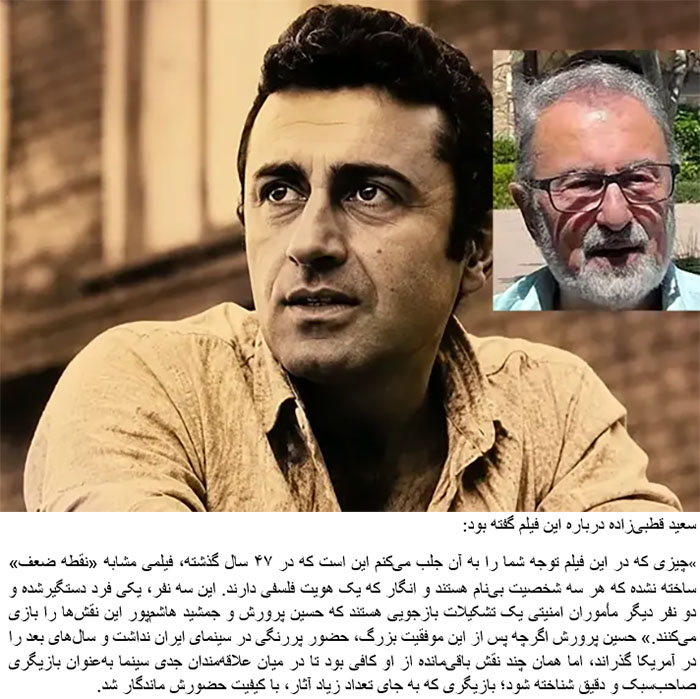
If The Crow introduced Parvaresh to a wider cinematic audience, Mohammad Reza Ealami’s Weak Point (Noghteh Za’f) became the defining film of his acting career.
Released in 1983, the film gave Parvaresh the acting award that made him part of Iranian cinema history.
The film was presented at the second edition of the Fajr Film Festival, and Parvaresh received the award for Best Actor in a Leading Role.
Several current reports describe him as the first recipient of the festival’s top male acting award, with some sources referring to the award as the Golden Plaque and others emphasizing the later terminology of the Crystal Simorgh.
For SEO purposes, it is therefore useful to distinguish the historical terminology:
Hossein Parvaresh was the first male acting award winner in the history of the Fajr Film Festival for his performance in Weak Point.
That is one of the strongest facts associated with his legacy.
Weak Point is a very different film from The Crow.
Where The Crow creates a broader urban and psychological environment, Weak Point is much more concentrated.
The film centers around interrogation, detention, confrontation, and uncertainty.
Parvaresh appears alongside Jamshid Hashempour, with the film constructing a tense relationship between a detainee and two security agents.
One of the unusual characteristics of the film is that the central characters are not presented as conventional fully individualized protagonists.
Instead, they become almost archetypal figures.
A detainee.
Two interrogators.
Three people caught inside a confined psychological space.
This stripped-down structure contributes to the film’s unusual atmosphere.
One of the reasons Weak Point remains interesting to students of Iranian cinema is the relationship between Parvaresh and Jamshid Hashempour.
The two actors represent different performance energies.
Hashempour would become particularly famous for his action-oriented screen presence in Iranian popular cinema.
Parvaresh, by contrast, was strongly associated with theater, academic acting, and restrained characterization.
Placing these different performers within the same claustrophobic environment creates an unusual dynamic.
The film does not depend on conventional action.
It depends on psychological pressure.
Dialogue becomes confrontation.
Silence becomes confrontation.
Physical space becomes confrontation.
And the actors become instruments through which the film explores uncertainty and power.