Amir Taghi Brings Heritage and Asiatic Cheetah Inspiration to Vogue’s 2026 Sustainable Fashion Challenge
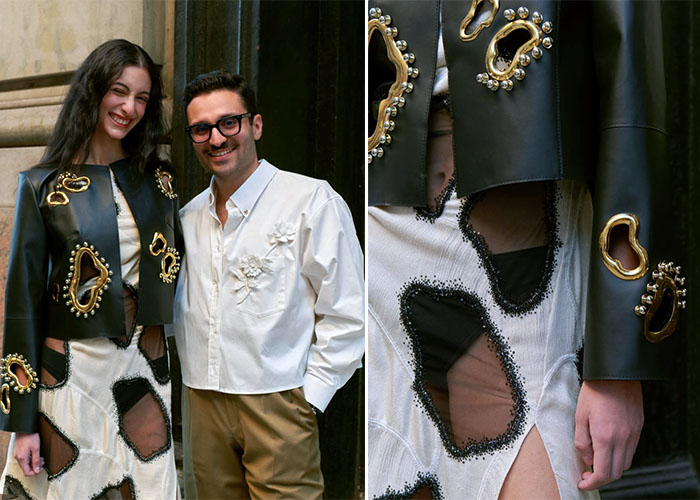
How the Asiatic Cheetah Pattern Influences the Coat
Animal-inspired design has a long history in fashion, from leopard-print garments to abstract interpretations of reptile scales and bird plumage. These references can be decorative, symbolic, or structural.
Taghi’s Asiatic cheetah-inspired coat offers a more specific interpretation because its visual reference is linked to a threatened species associated with Iran.
The coat’s cut-out spots translate the cheetah’s markings into a pattern that interacts with the garment’s surface. The effect depends on the relationship between the size of the openings, their distribution, the material’s thickness, and the overall silhouette.
Pattern placement is particularly important. If spots are distributed too uniformly, the garment can appear mechanical. If they are arranged with too much randomness, the intended visual reference may become difficult to recognize.
A successful translation balances repetition and variation. The spots need to suggest the natural pattern of the animal while remaining compatible with the proportions and construction of the coat.
The cut-outs also create visual contrast. Depending on the material underneath, the openings can reveal a different color, texture, or layer. Light and shadow may further emphasize the pattern as the wearer moves.
This is one of the advantages of working with structural details rather than relying exclusively on surface decoration. The design can change subtly according to the viewing angle and the garment’s movement.
The coat’s material choice is another important consideration. Faux leather provides a leather-like visual effect without requiring conventional animal leather, although the environmental profile of faux leather depends on its composition and manufacturing process.
Some alternatives rely heavily on synthetic polymers. Others incorporate plant-derived ingredients, recycled feedstocks, or agricultural by-products. These materials differ considerably in durability, flexibility, coating chemistry, repairability, and end-of-life options.
Consequently, the label “faux leather” should not automatically be interpreted as meaning fully plant-based or environmentally preferable. A material’s sustainability depends on its complete life cycle, including the resources used in production, its useful life, and how it can be disposed of or recovered.
In the context of the Material Innovation Challenge, the broader objective was to encourage designers to investigate alternatives and understand their creative possibilities.
Taghi’s coat demonstrates why material innovation is also a design question. A textile or leather alternative must not only meet environmental goals; it must also perform aesthetically and technically.
It needs to support the desired silhouette, retain its shape, accommodate the intended cut-outs, and withstand the stresses associated with wearing and movement.
For fashion designers, the challenge is to find a material that can satisfy these requirements without compromising the garment’s visual identity.
October 23, 2026 | 7:37 pm