Amir Taghi Brings Heritage and Asiatic Cheetah Inspiration to Vogue’s 2026 Sustainable Fashion Challenge
The 2026 CFDA/Vogue Fashion Fund: Why the Competition Matters
The CFDA/Vogue Fashion Fund is one of the established platforms for supporting emerging American fashion talent. Created through a partnership between the Council of Fashion Designers of America and Vogue, the program combines industry recognition with resources intended to help independent designers grow.
Fashion design requires more than creative ability. Independent labels must manage production, sourcing, cash flow, pricing, distribution, marketing, and customer relationships while maintaining a consistent design identity.
For a young fashion business, these operational challenges can be as demanding as the creative process itself. Producing high-quality garments requires relationships with manufacturers, textile suppliers, patternmakers, and specialist craftspeople. Developing a customer base requires visibility, a clear market position, and an understanding of how products meet customer expectations.
The Fashion Fund addresses some of these challenges by providing finalists with access to industry expertise and professional mentorship.
The 2026 program offered a top award of $300,000, while the two runners-up received $100,000 each. The other finalists also benefited from the program’s industry exposure and mentorship opportunities.
The distinction matters for accurate reporting, but it does not diminish the value of reaching the finalist stage. Being selected among ten designers places a label within a competitive group receiving attention from influential fashion professionals.
The program also gives designers a setting in which to demonstrate how they respond to creative constraints. The material innovation challenge required participants to work with sustainable and bio-based textile options, pushing them to investigate unfamiliar materials and rethink their usual processes.
For Taghi, that framework created a meeting point between his interest in Iranian artistic traditions and the wider industry’s search for alternatives to conventional fashion materials.
The challenge also illustrates how fashion competitions can function as more than promotional events. They can encourage experimentation, introduce designers to new suppliers, and create opportunities for conversations between creative professionals, material innovators, and sustainability advocates.
The Asiatic Cheetah: An Endangered Animal Inspiring Fashion Design
One of the most distinctive elements of Amir Taghi’s look is its connection to the Asiatic cheetah, a critically endangered subspecies of cheetah associated today with Iran.
Known for its slender build, exceptional speed, and characteristic spotted coat, the Asiatic cheetah occupies a unique place in the natural heritage of the region. Its declining population has made it an important focus of conservation efforts.
The species is especially vulnerable because of its small population, habitat pressures, and the difficulties involved in protecting widely dispersed animals across large landscapes. Conservation requires more than protecting individual animals. It also involves maintaining suitable habitat, preserving movement corridors, monitoring populations, and addressing the pressures that threaten their survival.
The Asiatic cheetah’s visual characteristics have also made it a compelling reference for designers interested in animal-inspired patterns. Its spots create an irregular arrangement of marks that can be translated into prints, perforations, embroidery, cut-outs, and textured surfaces.
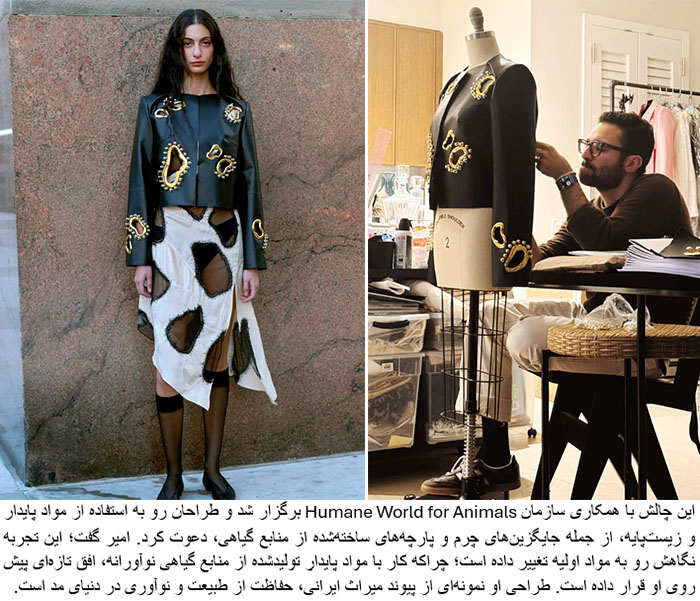
Taghi’s design uses that visual language in a contemporary coat. Rather than simply reproducing a spotted print, the garment incorporates cut-out details that give the pattern a structural role.
This distinction changes the relationship between the inspiration and the finished clothing. A printed pattern sits on the surface of a garment, while cut-outs interact with the garment’s construction and reveal the material beneath. The pattern becomes part of the design’s physical architecture.
The result connects the coat to the cheetah without requiring an actual animal-derived material.
That connection is particularly appropriate within a challenge focused on sustainable and cruelty-free fashion. Wildlife can serve as a source of visual inspiration without being treated as a resource for clothing production.
However, the ecological significance of the design should be understood carefully. A fashion look inspired by an endangered species can help create awareness, but it does not automatically demonstrate a measurable conservation benefit. Such an impact would depend on additional factors, including educational outreach, partnerships with conservation organizations, donations, or other direct support.
The strongest interpretation of Taghi’s design is therefore that it brings the Asiatic cheetah into a contemporary cultural conversation while avoiding the need to use the animal itself as a material.
It also raises an important question for fashion: can clothing communicate the value of biodiversity while encouraging more responsible material choices?
Designers cannot solve wildlife conservation challenges through aesthetics alone. Nevertheless, fashion has considerable cultural visibility, and designers can use that visibility to encourage audiences to notice threatened species and consider the relationship between human consumption and the natural world.
For an animal as rare as the Asiatic cheetah, visibility can be valuable when it is paired with accurate information about the species and its conservation needs.
October 23, 2026 | 7:37 pm