6 Signs of Heart Disease That May Appear on the Face: From Earlobe Creases to Facial Redness
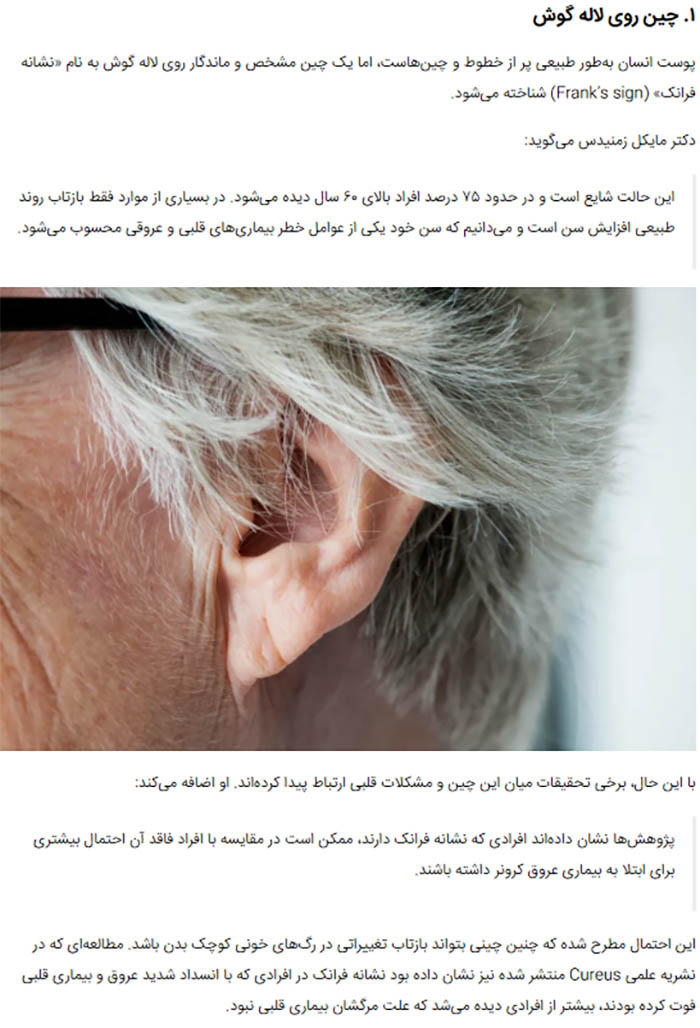
1. Earlobe Crease: What Is Frank’s Sign?
One of the most widely discussed visible findings associated with cardiovascular disease is a diagonal crease across the earlobe.
This is commonly called Frank’s sign, named after the physician who described the association.
The crease generally extends diagonally from the lower edge of the earlobe toward the outer portion of the ear.
At first glance, it may seem like an ordinary wrinkle. And in many people, it is.
What does an earlobe crease mean?
The earlobe naturally develops folds and wrinkles as people age. Loss of skin elasticity, changes in collagen and repeated movement can all contribute to lines around the ears.
An earlobe crease therefore does not mean that a person necessarily has heart disease.
However, researchers have investigated whether a diagonal earlobe crease may be associated with coronary artery disease and atherosclerosis.
Some studies have reported an association between Frank’s sign and cardiovascular disease, while other research has questioned how useful the finding is as a predictor.
The relationship is therefore not sufficiently reliable for doctors to diagnose coronary artery disease simply by examining the earlobe.
Why might an earlobe crease be associated with cardiovascular disease?
One theory is that changes affecting small blood vessels and connective tissue could potentially contribute to visible changes in the earlobe as well as vascular changes elsewhere in the body.
Another explanation is much simpler: aging.
Older people are more likely to develop earlobe wrinkles, and older age is also one of the strongest risk factors for cardiovascular disease.
That creates a potential problem called confounding.
In other words, the earlobe crease may appear to be associated with heart disease partly because both become more common with age.
Is Frank’s sign a reliable heart disease test?
No.
A diagonal earlobe crease should be considered, at most, a possible physical clue rather than a diagnostic test.
If someone has Frank’s sign but has normal blood pressure, healthy cholesterol levels, no diabetes, does not smoke and has no significant family history of premature cardiovascular disease, the crease alone does not establish that a heart problem exists.
On the other hand, if an earlobe crease appears together with several cardiovascular risk factors, it may be reasonable to make sure those risk factors are being evaluated.
What should you do if you notice an earlobe crease?
There is no need to panic.
Instead, consider the broader picture.
If you are concerned about your cardiovascular health, useful questions include:
- When was your last cholesterol test?
- Is your blood pressure within a healthy range?
- Do you have diabetes or elevated blood sugar?
- Do you smoke?
- Are you physically active?
- Is there a family history of early heart disease?
- Do you experience chest discomfort or unusual breathlessness?
- Have you noticed a recent decline in your exercise tolerance?
Those factors provide considerably more useful information about cardiovascular risk than an earlobe crease alone.
August 30, 2026 | 10:23 pm