6 Signs of Heart Disease That May Appear on the Face: From Earlobe Creases to Facial Redness
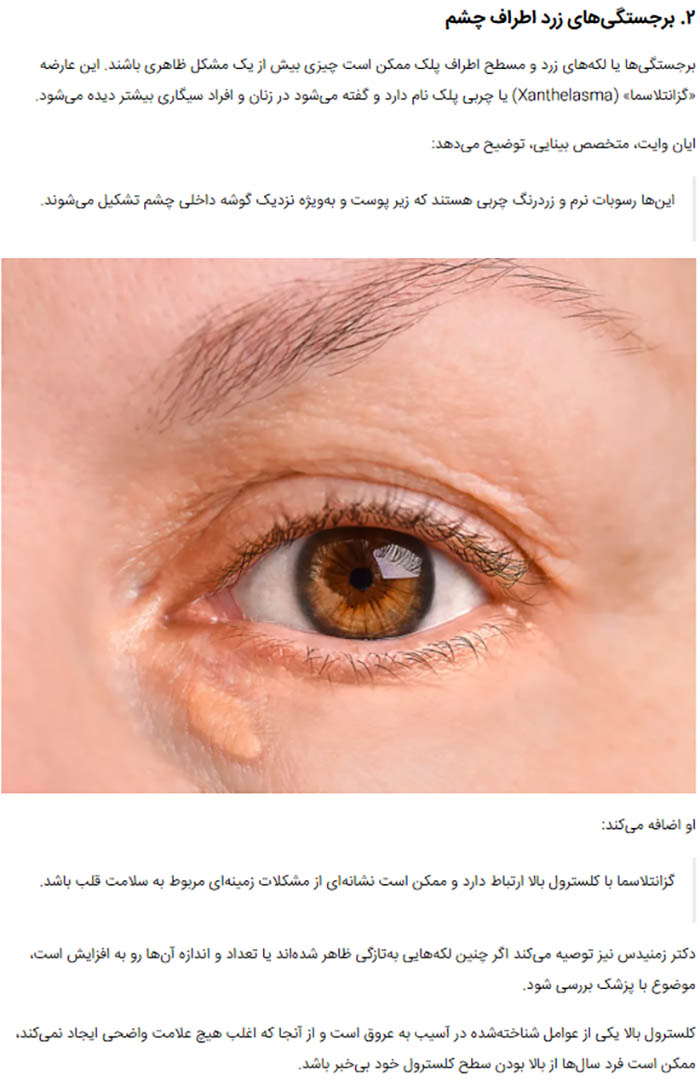
2. Yellow Bumps Around the Eyes: Xanthelasma and Cholesterol
Another facial finding that can attract attention is the appearance of yellowish patches or bumps around the eyelids.
These deposits are called xanthelasma.
They often develop near the inner corners of the eyes and may appear as soft, yellow or yellowish-white plaques beneath the skin.
Unlike ordinary wrinkles, xanthelasma can be quite distinctive.
What causes xanthelasma?
Xanthelasma involves deposits of lipid-rich material in the skin around the eyelids.
One important association is with abnormal blood lipid levels, particularly elevated cholesterol.
However, not everyone with xanthelasma has high cholesterol.
The condition can occur in people whose cholesterol levels are normal, and therefore it should not be interpreted as proof that someone has hypercholesterolemia.
Nevertheless, newly developed xanthelasma can be a reason to consider having cholesterol levels checked.
Is xanthelasma a sign of high cholesterol?
It can be an associated finding, but it is not a definitive diagnostic sign.
This distinction is important.
A person may have xanthelasma with normal cholesterol, while another person may have very high cholesterol without any visible skin deposits.
Because high cholesterol often produces no symptoms, a blood test remains much more informative.
Why is high cholesterol important for heart health?
Cholesterol is essential for the body. It is involved in cell membranes, hormones and other biological processes.
The problem occurs when certain blood lipid levels become unhealthy, particularly when LDL cholesterol is elevated.
Over time, excess cholesterol can contribute to the formation of atherosclerotic plaque in artery walls.
Atherosclerosis can narrow the arteries and interfere with blood flow.
When coronary arteries become significantly narrowed or blocked, the result can be coronary artery disease, heart attack or other cardiovascular complications.
This is why a seemingly cosmetic finding around the eye can sometimes provide a reason to investigate a person’s metabolic and cardiovascular health.
Can xanthelasma disappear on its own?
Usually, xanthelasma does not simply disappear without treatment.
People who are bothered by its appearance can discuss treatment options with a dermatologist or other qualified healthcare professional.
Possible treatments may include procedures designed to remove or reduce the deposits.
However, treating the visible lesion does not necessarily address the underlying reason it developed.
If abnormal cholesterol or another lipid disorder is present, that underlying issue should also be evaluated.
Xanthelasma and familial hypercholesterolemia
In some cases, cholesterol-related physical findings can be especially relevant when they occur at a young age.
Familial hypercholesterolemia, commonly abbreviated as FH, is an inherited condition characterized by very high LDL cholesterol.
People with FH can have a substantially increased risk of premature cardiovascular disease.
A person who develops cholesterol deposits around the eyes at an unusually young age, particularly alongside a strong family history of early heart disease, may benefit from discussing cholesterol testing and possible inherited lipid disorders with a healthcare professional.
August 30, 2026 | 10:23 pm