Who Is Babak Takhti? Gholamreza Takhti’s Only Son, His Family, Career, and His Father’s Controversial Death
Did SAVAK kill Gholamreza Takhti?
The claim that SAVAK killed Takhti became a widely discussed theory after his death, but the existence of the theory is not proof that it happened. Babak Takhti has publicly rejected the murder explanation in the interview described in the source material. Historical claims should be evaluated against documentary evidence and reliable scholarship.
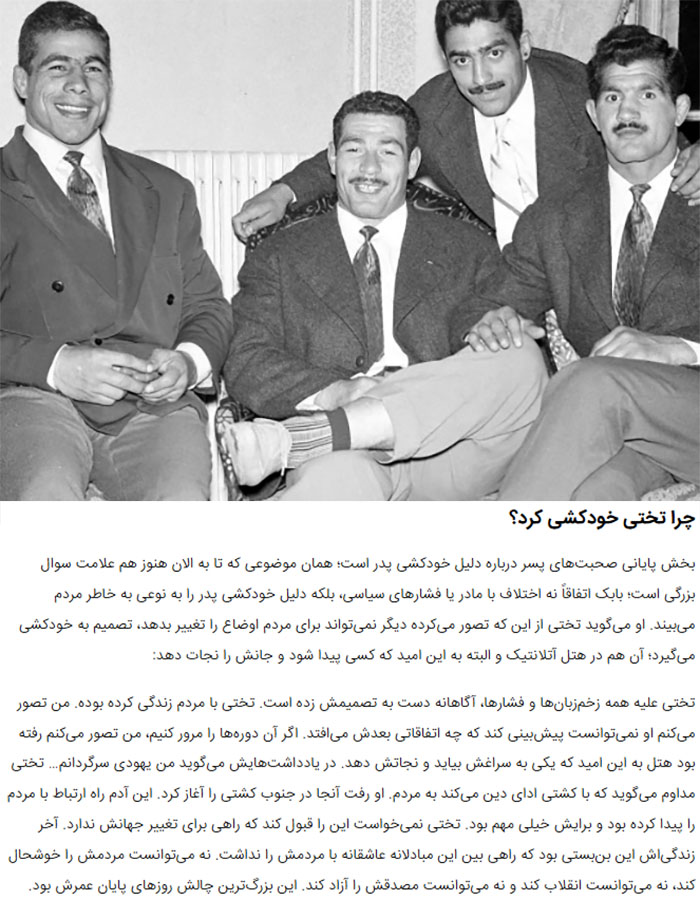
Why does Babak Takhti say his father committed suicide?
In the reported interview, Babak explains that he reconsidered the murder theory after investigating the circumstances of his father’s death and speaking with the manager of the Atlantic Hotel. He also offers a personal interpretation of his father’s final state of mind. These are his stated views and should be distinguished from independently established historical facts.
Why is Gholamreza Takhti called Jahan Pahlavan?
The title means Champion of the World. It reflects his sporting achievements and the moral qualities associated with his public reputation, including generosity, humility and honorable conduct.
Why does Babak Takhti criticize media coverage of his father’s death?
Babak argues that sensationalist reporting and speculation about his parents’ marriage distract from the historical context and can unfairly damage his mother’s reputation. He believes his father’s life should be examined through reliable evidence rather than gossip.
What is the significance of the Atlantic Hotel controversy?
The Atlantic Hotel became central to competing explanations of Takhti’s death because it was where his body was found and was located near SAVAK’s headquarters. The location helped fuel suspicion, but it does not independently prove a murder theory.
Conclusion: Babak Takhti’s Search for Truth About His Father’s Legacy
Babak Takhti’s life is closely connected to the legacy of Gholamreza Takhti, one of Iran’s most celebrated wrestlers. Yet his own professional path has been defined by writing, publishing and an effort to understand the man behind the national legend.
Born in 1967, Babak lost his father when he was still an infant. He grew up in the shadow of a public figure whose sporting achievements, political convictions and unexpected death became part of Iran’s collective memory.
His book In Search of a Father reflects the challenge of understanding a parent through records, recollections and stories rather than personal experience. His later comments about the circumstances of Takhti’s death show that this search has involved questioning narratives he once believed.
Babak’s account challenges the claim that his father was murdered by SAVAK, criticizes sensationalist stories about his parents’ marriage and emphasizes the importance of Takhti’s relationship with ordinary people and his support for Mossadegh.
These statements provide a significant family perspective, but the historical debate must still distinguish personal interpretation from independently verifiable evidence.
The broader story includes Shahla Tavakoli, whose life was affected by the public controversy; Moniro Ravanipour, Babak’s wife and an accomplished writer; and their son, Gholamreza, who carries the name of the celebrated grandfather he never knew personally.
Ultimately, the story of Babak Takhti is about the complicated relationship between family and public memory. His father remains a symbol of athletic achievement, generosity and political conviction, while Babak has chosen to examine that legacy through literature and critical reflection.
Understanding Babak Takhti means recognizing both the enduring importance of Gholamreza Takhti and the son’s independent effort to separate historical evidence from rumor, sensationalism and national mythology.