World Leaders Gather for United Nations General Assembly as President Masoud Pezeshkian Delivers Wartime Address
Pezeshkian’s Medical Background
Before entering politics, Masoud Pezeshkian trained as a physician.
His professional background in medicine has been part of his public biography and political identity.
He subsequently entered Iranian politics and served as a member of parliament.
He also served as Iran’s health minister under President Mohammad Khatami.
His medical background helped distinguish him from many other senior Iranian politicians and contributed to his public image as a technocratic politician.
Nevertheless, the central issues of his presidency have increasingly been foreign policy, economic pressure, national security and Iran’s relationship with the United States.
Iran’s President at a Critical Moment
Pezeshkian’s September 23 UN appearance came at a moment when Iran was under extraordinary international pressure.
The country was engaged in a major confrontation with the United States and Israel, while diplomatic channels were simultaneously being explored.
That combination of military conflict and diplomacy defined much of the atmosphere surrounding the 81st UN General Assembly.
The Iranian president therefore used his speech not simply to discuss Iran’s domestic priorities but to present Tehran’s account of the international crisis.
His decision to display images of Khamenei and children killed in the conflict reinforced the Iranian government’s narrative about the war.
The United States Delegation Leaves During Pezeshkian’s Speech
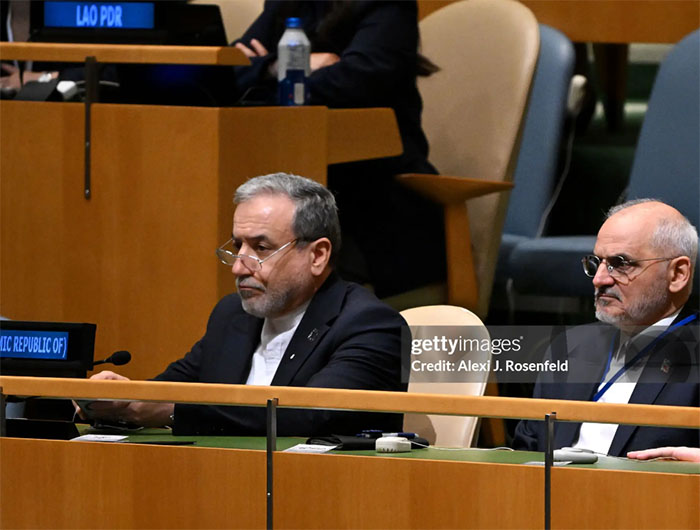
The diplomatic tension was also visible inside the General Assembly chamber.
Reporting on Pezeshkian’s address said the U.S. delegation walked out at the beginning of his speech.
The departure highlighted the depth of disagreement between Washington and Tehran.
The two countries were simultaneously communicating through intermediaries outside the chamber while presenting competing narratives inside it.
This combination is characteristic of high-level diplomacy during periods of conflict.
Public speeches can be directed toward international audiences and domestic constituencies, while private diplomatic channels focus on specific negotiations and potential agreements.
September 23, 2026 | 3:13 pm