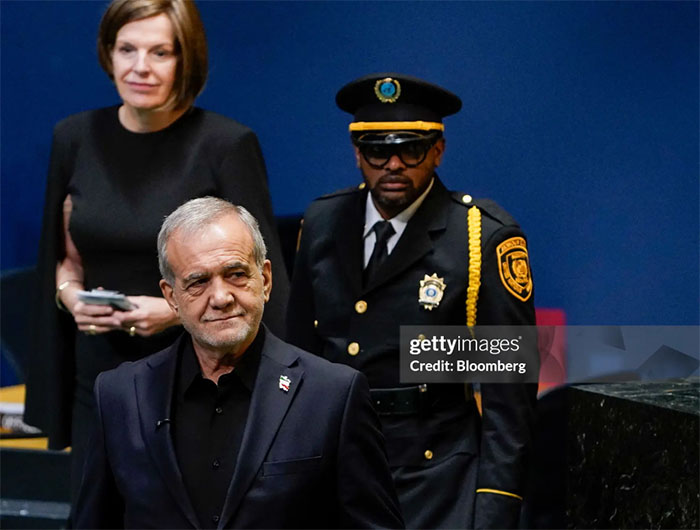
World Leaders Gather for United Nations General Assembly as President Masoud Pezeshkian Delivers Wartime Address
Strait of Hormuz and Global Energy Security
The Strait of Hormuz has long been a central concern in discussions about Iran’s regional strategy.
The waterway connects the Persian Gulf with the Gulf of Oman and the wider Arabian Sea. A substantial share of global oil and gas shipments passes through the region.
The possibility of restrictions on shipping through the Strait has therefore generated concern among energy markets and governments.
Reuters reported that Iranian officials had offered to reopen the Strait within a week if the United States reduced military pressure and lifted its blockade.
The proposal demonstrates how the current Iran conflict has implications for global energy security.
Any diplomatic agreement that reduces military tensions could therefore affect not only Iran and the United States but also oil-producing countries, shipping companies, Asian energy importers and European economies.
Iran’s President and the Islamic Republic’s Political System
Understanding Pezeshkian’s position requires understanding Iran’s political structure.
Iran combines elected institutions with powerful unelected or indirectly selected institutions.
The president is elected by voters and leads the executive government, while the Supreme Leader has broad constitutional authority over major areas including the armed forces and strategic national policy.
The Guardian Council also plays a significant role by reviewing legislation and determining which candidates can participate in elections.
The Islamic Revolutionary Guard Corps has major political, economic and military influence.
This means that the Iranian president operates within a complex system of overlapping institutions.
Pezeshkian can represent Iran in international diplomacy and shape the government’s public message, but his statements should not automatically be interpreted as representing the personal authority of every Iranian institution.
This is particularly important when analyzing negotiations involving the United States.
Pezeshkian’s Domestic Political Image
Pezeshkian entered the presidency with a reputation as a politician associated with reformist and moderate elements within Iran’s electoral system.
His election attracted attention because he campaigned on issues including improving relations with the outside world, addressing economic difficulties and changing aspects of domestic governance.
However, his presidency has unfolded within severe constraints.
Iran’s economic situation has been affected by international sanctions, inflation, currency pressures and restrictions on trade and investment.
The government also faces domestic political disagreements and competing demands from reformist voters, conservative political factions and security institutions.
The escalation of conflict with the United States and Israel has further reduced the space available for domestic political reform.
September 23, 2026 | 3:13 pm