The One Billion Toman Kurmanji Dress of Khorasan: Why Is This Traditional Kurdish Clothing So Expensive?
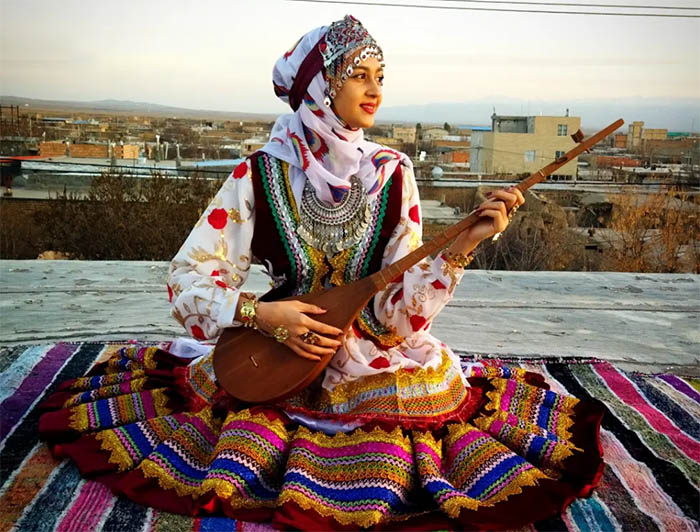
The Kurmanji Women’s Shirt: The “Gross” or “Cross”
One of the basic components of the traditional women’s outfit is the garment sometimes described as “gross” or “cross.”
It is generally a collarless shirt with long sleeves.
The lower part of the shirt can be pleated, while colorful decorative stripes may be added to the sleeve edges and lower section.
Although the shirt may appear comparatively simple when viewed next to the heavily decorated vest, its construction contributes to the overall silhouette of the outfit.
The shirt creates the base layer over which the skirts, vest, and other decorative components are worn.
Its colors and decorative details also contribute to the overall visual harmony.
In traditional clothing, even seemingly small borders can have significant importance.
A colored stripe at the end of a sleeve can connect visually with the colors of the skirt, ribbons, head covering, or embroidered decorations.
The outfit therefore functions as a coordinated system rather than a collection of unrelated garments.
Colors and Social Meaning
Color is an important element of traditional clothing.
Although color practices can vary among communities and families, certain Kurmanji traditions associate different colors with social categories.
For example, red may be used more prominently for married women in some communities, while orange and yellow can be associated with girls.
Such practices should not be treated as universal rules for every Kurmanji community.
Traditional dress is diverse, and customs can vary geographically and historically.
Nevertheless, the existence of such associations demonstrates that color can carry meaning.
A red skirt may not simply be a red skirt.
Within a specific cultural context, its color may contribute to the social language of the outfit.