Inflation 2026: Tehran Residents Struggle With Soaring Food Prices and the Rising Cost of Living
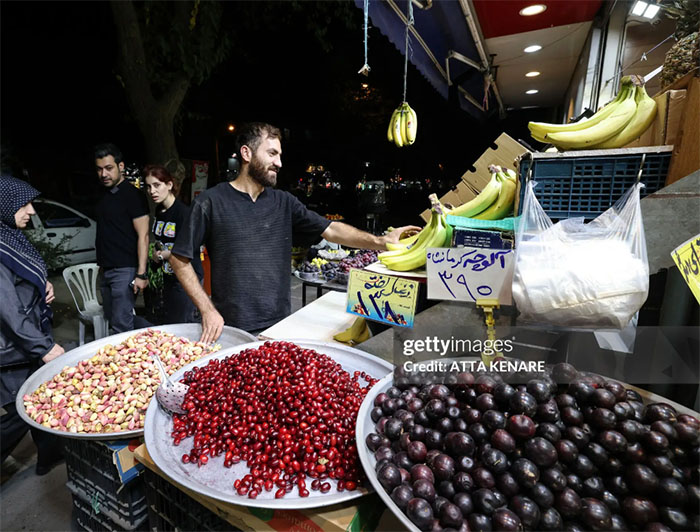
Tehran Shopping Streets: A Picture of Economic Pressure
The September 15 photographs from southern Tehran provide a useful visual window into the crisis.
People continue shopping.
Retailers continue operating.
Fruit remains available.
Sports equipment remains displayed.
The existence of active markets does not mean that consumers are unaffected by inflation.
In fact, bustling markets can coexist with severe economic distress.
Consumers still need food.
Businesses still need customers.
Workers still need income.
The important question is not simply whether people are shopping.
It is what they can afford to buy.
A customer may enter a store but purchase less.
A family may continue buying fruit but choose cheaper varieties.
A consumer may replace imported goods with domestic alternatives.
A restaurant customer may order less frequently.
A household may reduce meat consumption.
A student may postpone buying clothes or electronics.
These behavioral changes are difficult to capture in a single photograph.
Yet they are central to understanding what inflation does to society.
The “Cost of Living in Tehran” Is Changing Rapidly
Searching for cost of living in Tehran 2026 can produce very different numbers depending on the source, exchange rate, neighborhood and lifestyle.
That variability itself reflects the instability of the Iranian economy.
Official exchange rates and open-market exchange rates can differ.
Housing costs vary dramatically between neighborhoods.
Food prices change rapidly.
Imported products can be particularly volatile.
Utilities and transportation costs can also change as government policies evolve.
Crowd-sourced databases can provide useful snapshots, but they are not substitutes for official household expenditure statistics.
One current Tehran cost-of-living estimate places monthly costs for a single person at more than 2 billion rials and for a family of four at more than 3.2 billion rials, but the source explicitly warns that its estimates are based on limited data.
Such figures should therefore be used cautiously.
The broader conclusion is more important: the purchasing power of Iranian households has deteriorated sharply.
September 17, 2026 | 12:39 pm