Hossein Kheirandish: Traditional Medicine Controversies, Cupping Research Institute, University Dispute and Arrest
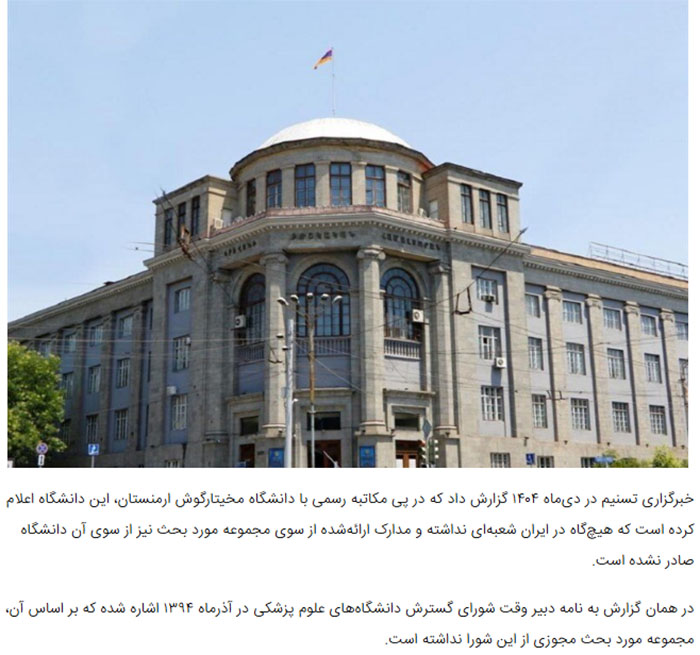
6. The Mkhitar Gosh University Controversy in Armenia
Perhaps the most consequential controversy associated with Kheirandish’s public history concerns an educational institution that presented itself as an Iranian branch of Mkhitar Gosh University in Armenia.
The case involved allegations of unauthorized academic activity, misleading representations concerning university affiliation, and the issuance of educational credentials.
It also raised questions about the responsibilities of organizations offering medical education and the importance of verifying international university accreditation.
The Beginning of the Educational Institution
According to reporting by Tasnim News Agency, the educational entity began its activities during the 2000s.
It presented itself as an institution connected to Mkhitar Gosh University in Armenia and advertised opportunities for students interested in medicine and traditional medicine.
The institution reportedly promoted admission through scientific interviews rather than the conventional university entrance process.
Prospective students were told that they could study at the institution and obtain university qualifications.
Some students reportedly believed that they were enrolling in an authorized Iranian branch of an Armenian university.
Payments were reportedly collected in foreign currency.
The arrangement became controversial when students attempted to use their qualifications for further education or recognition abroad.
What Did Mkhitar Gosh University Say?
The controversy became more serious after Tasnim contacted Mkhitar Gosh University directly.
In a report published on December 28, 2025, the news agency described the university’s response to questions about its alleged Iranian branch.
According to the report, the Armenian university stated that it had never established a branch in Iran.
It also said that the documents submitted to it had not been issued by the university.
The response challenged the central claim upon which the Iranian educational entity had reportedly based its activities.
The university’s statement was significant because international academic recognition depends on the actual legal relationship between an educational institution and the university whose name it uses.
A school cannot establish legitimate international affiliation simply by using the name of a foreign university or issuing documents that resemble university credentials.
Official authorization, institutional agreements, recognition by relevant authorities, and verification by the awarding university are essential considerations.
The Ministry of Health Authorization Issue
The controversy also involved questions about the educational entity’s authorization within Iran.
Tasnim cited correspondence from the then-secretary of the Council for the Expansion of Universities of Medical Sciences.
The letter, dated Azar 1394 in the Iranian calendar, indicated that the institution did not hold authorization from that council.
This raised further questions about the legal status of the educational activities and the qualifications being offered.
The case illustrated the importance of checking both domestic authorization and international university recognition before enrolling in a medical education program.
Students and Financial Losses
Several students reportedly filed complaints against individuals associated with the educational institution.
Tasnim’s reporting described students who believed they were receiving education through an authorized international university arrangement.
One account concerned a student whose family reportedly paid an initial amount of $1,070 for registration and interview-related expenses.
The student’s education reportedly continued for several years before questions emerged about the authenticity and recognition of the qualifications.
For students, such situations can have serious consequences.
Years of academic work may become difficult to transfer or recognize if the institution lacks the necessary authorization.
Families may also experience substantial financial losses, particularly when tuition and registration payments are collected in foreign currency.
The case therefore became an important example of the risks associated with unverified international university affiliations.
November 8, 2026 | 5:18 pm