Hossein Kheirandish: Traditional Medicine Controversies, Cupping Research Institute, University Dispute and Arrest
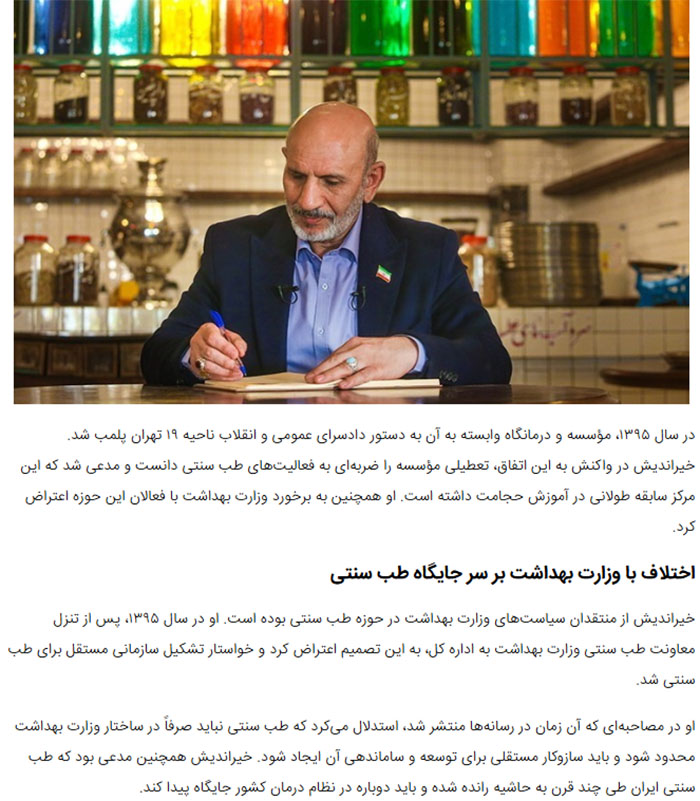
2. Hossein Kheirandish and His Dispute with Iran’s Ministry of Health
Kheirandish’s disagreements with the Ministry of Health were not limited to the closure of the Cupping Research Institute.
He also criticized broader administrative decisions concerning the institutional position of traditional medicine in Iran.
In 2016, the Ministry’s Deputy for Traditional Medicine was downgraded to a General Directorate.
The change triggered objections from several advocates of traditional medicine, including Kheirandish.
Calls for an Independent Traditional Medicine Organization
Kheirandish argued that traditional Iranian medicine needed an independent administrative structure capable of organizing its development.
In his view, placing traditional medicine entirely within the existing structure of the Ministry of Health limited its ability to develop independently.
He called for the establishment of a separate organization dedicated to traditional medicine, with responsibilities extending beyond education and research to include institutional planning and the coordination of practitioners.
His argument was based partly on the historical position of traditional Iranian medicine.
Kheirandish claimed that traditional medicine had experienced a prolonged period of marginalization over several centuries and needed stronger institutional support to regain its place within the national healthcare system.
He also argued that developing a medical tradition required long-term planning, qualified educators, research infrastructure, educational materials, and appropriate institutional support.
These comments reflected a broader debate in Iran concerning the relationship between traditional medicine and modern healthcare.
Traditional Medicine and Conventional Medicine
In later interviews, Kheirandish discussed the importance of combining traditional and conventional medicine.
During a 2020 interview, he emphasized that modern medical knowledge should not simply be abandoned.
Instead, he argued that traditional medicine should be incorporated into a broader healthcare framework.
This position became an important part of his public messaging, particularly in television programs and online interviews.
However, the integration of traditional medical practices into conventional healthcare requires more than historical recognition or public support. Individual treatments must be evaluated according to reliable clinical evidence, patient safety requirements, and appropriate medical standards.
This distinction is central to understanding the controversies surrounding Kheirandish’s public health statements.
The Claim About Performing Hijama on Ayatollah Khamenei
One of Kheirandish’s most widely discussed personal claims emerged during a 2020 interview on the online program Roo-dar-Roo, translated as Face-to-Face.
During the program, he discussed his personal and political background, his involvement in traditional medicine, and his experiences within Iranian political and cultural circles.
He also recounted an anecdote about performing hijama on Iran’s Supreme Leader, Ayatollah Ali Khamenei.
Kheirandish claimed that he had personally carried out the procedure.
The statement attracted attention because of the political and symbolic importance of the individual involved.
It also became part of the broader media coverage surrounding Kheirandish’s public profile.
November 8, 2026 | 5:18 pm