U.S. Secretary of State Marco Rubio Meets Italian Prime Minister Giorgia Meloni in Rome
Introduction
On May 8, 2026, a highly anticipated diplomatic meeting took place in Rome, Italy, between U.S. Secretary of State Marco Rubio and Italian Prime Minister Giorgia Meloni at Palazzo Chigi. The meeting immediately attracted global attention because it occurred during a period of increasing geopolitical tension involving the United States, Europe, Iran, NATO, and the Vatican.
The meeting between Marco Rubio and Giorgia Meloni comes at a critical time in international politics. Relations between Washington and Rome have experienced visible strain following President Donald Trump’s public criticism of the Pope, as well as disagreements surrounding the escalating conflict involving Iran. Italy, which has traditionally maintained strong transatlantic relations with the United States, has found itself navigating a delicate diplomatic balance between supporting NATO allies and responding to domestic opposition toward military escalation in the Middle East.
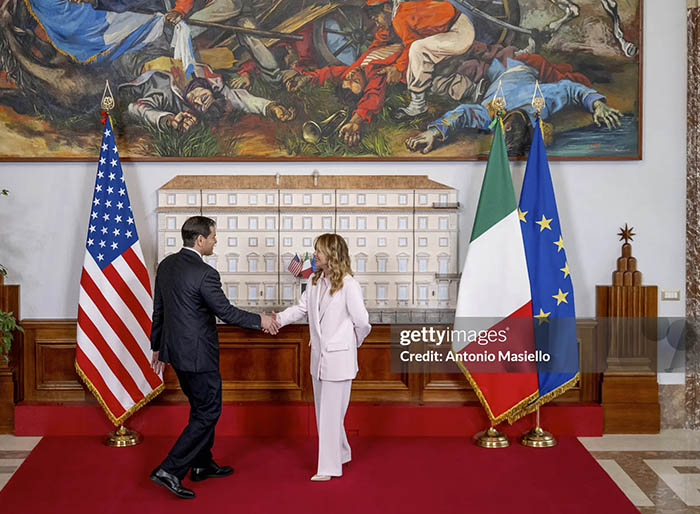
Photos from Palazzo Chigi showed Giorgia Meloni welcoming Marco Rubio with a formal handshake before the closed-door talks began. International media outlets, including Getty Images and Bloomberg, highlighted the symbolism of the meeting, portraying it as a diplomatic effort to repair tensions and reaffirm cooperation between the United States and Italy.
The Rome meeting quickly became one of the most discussed international political developments of the week. Analysts focused on several major themes surrounding the summit, including U.S.-Italy relations, the Iran conflict, NATO strategy, Vatican diplomacy, European Union foreign policy, migration concerns in the Mediterranean, energy security, sanctions policy, and the broader future of Western alliances.
This comprehensive analysis explores every aspect of the Marco Rubio and Giorgia Meloni meeting in Rome, examining the political background, diplomatic implications, international reactions, strategic interests, and future consequences for global politics.