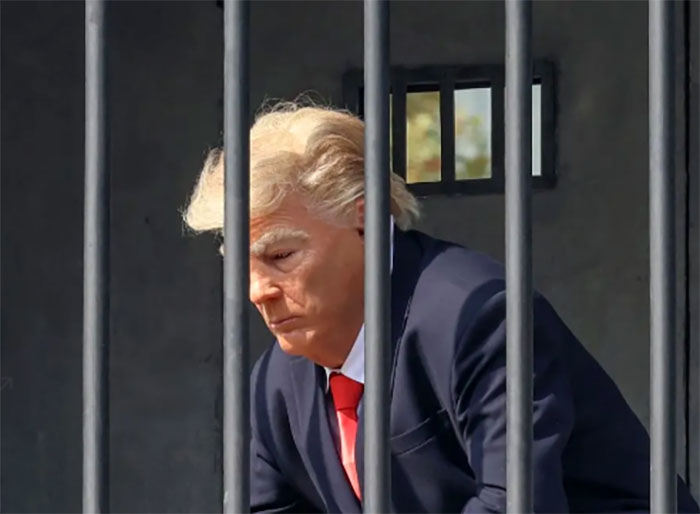
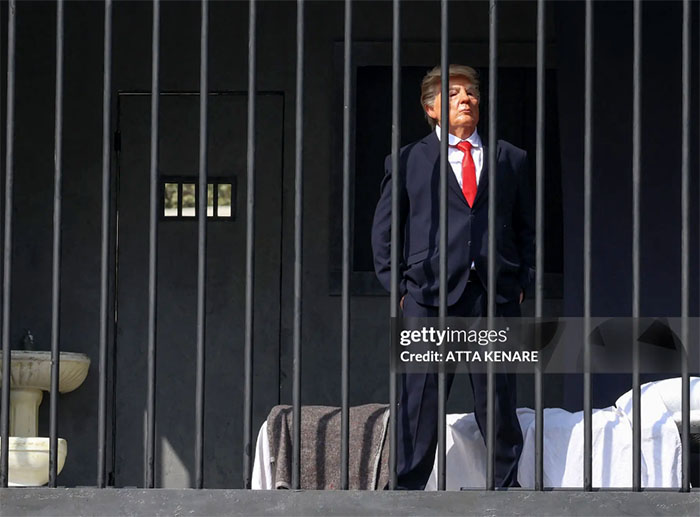
Donald Trump Mask in Tehran: Actor Appears in Mock Prison Cell at Tajrish Square
The power of visual political communication
A large billboard can communicate a political idea to thousands of people who may never read a detailed policy statement or news article.
The image may feature a leader’s face, a symbolic object, a national flag or a visual reference to a major geopolitical issue. These elements can convey a basic message at a glance.
Political imagery also offers opportunities for exaggeration. A leader can be depicted as trapped, silenced, defeated or placed in an implausible situation to communicate criticism.
The effectiveness of such imagery depends on the familiarity of its symbols and the context in which the audience sees them.
In the Tehran Trump installation, the mask identifies the political figure, while the cell supplies the central metaphor. The structure does much of the communicative work before the viewer reads a caption.
Why the mock prison cell is different
A static billboard shows a finished composition. A live installation can introduce an additional dimension through the presence of an actor.
The performer can pose within the cell, creating different visual arrangements for photographers. The physical structure also allows the camera to capture depth, perspective and the relationship between the performer and the surrounding street.
This can make the resulting photographs feel more immediate than a conventional poster.
The images also invite viewers to examine the scene as a constructed object. The cell, the mask and the actor’s position form a small theatrical environment embedded within the larger urban setting.
The contrast between an internationally prominent political leader and an ordinary-looking prison enclosure gives the image its distinctive visual character.
Political billboards in the age of social media
Although the installation is physically located in Tehran, photographs can circulate internationally within minutes of publication.
News organizations, photo agencies, online publishers and social media users can share the scene with audiences across different countries and political backgrounds.
The photograph can therefore reach people who have no direct experience of Tehran and may know the city primarily through international reporting.
This wider distribution can change how an installation functions. The original display addresses people who encounter it in the street, while the photograph becomes an object of interpretation in a much larger media environment.
The image may be shared as political news, a cultural curiosity, a piece of satire or an example of propaganda.
For publishers, the combination of a recognizable public figure, an unexpected visual and a clear location can make the image attractive for news coverage and search discovery.
October 21, 2026 | 2:15 pm