An Unusual Wedding Ceremony in Tehran Becomes a Memorial for the Victims of the Kohestak, Sirik Tragedy
Persian Wedding Traditions and the Emotional Meaning of Celebration
Iranian weddings vary considerably according to regional customs, family preferences, religious practices and personal choices. There is no single format that represents every Iranian wedding.
Nevertheless, wedding celebrations often hold significance beyond the couple themselves. They can bring together relatives and friends who may live in different cities or have limited opportunities to meet.
The preparation can involve selecting clothing, arranging decorations, preparing food, coordinating guests and organizing photographs that preserve the occasion.
In southern Iran, as elsewhere in the country, local customs and family traditions influence how weddings are organized. Some celebrations take place in dedicated venues, while others are held in family homes or compounds.
These differences are important when considering the reported tragedy in Kohestak, where international reporting described a family wedding gathering in a residential setting.
A wedding held in a home can become a gathering place for an extended family and a wider neighborhood. Guests may arrive over a period of time, and different parts of the residence may be used for different aspects of the celebration.
When a gathering of this kind is affected by violence, the impact can extend across multiple households and social networks.
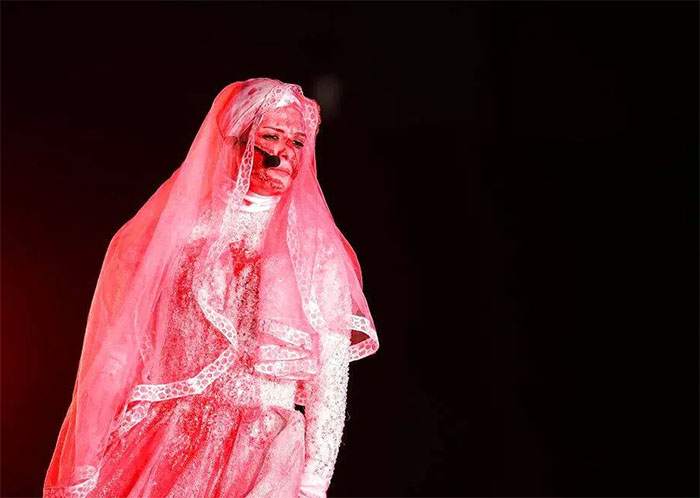
The wedding imagery used in the Tehran installation may resonate with viewers because it refers to an experience many people understand: the anticipation of a celebration and the expectation that a wedding will be remembered as a happy occasion.
In a memorial context, these associations become more complex. The display can evoke both the promise of a wedding and the sorrow attached to a celebration that ended in tragedy.
This does not mean that every viewer will interpret the installation in the same way. Public memorials can provoke different reactions depending on personal experiences, political perspectives and familiarity with the event being commemorated.
Some may see the display primarily as an act of remembrance. Others may focus on its unconventional visual design or the political circumstances surrounding the incident.
A careful photo report can acknowledge this range of possible interpretations while remaining clear about the event’s reported purpose.
The Slogan “It’s a Crime to Miss This Sight”
The phrase “It’s a crime to miss this sight” is one of the most striking details in the supplied description of the Tehran installation.
Its wording uses exaggeration to attract attention. Rather than simply inviting passersby to look, it frames the act of seeing the display as something that should not be overlooked.
In a crowded urban environment, where people encounter advertisements, signs, vehicles and public messages throughout the day, a short slogan can help a display stand out.
The phrase also takes on a different tone when placed alongside the reported memorial connection.
A wedding-themed display might ordinarily use language about love, celebration or a new beginning. Here, the slogan encourages attention to a scene associated with the victims of a tragic event.
The wording can therefore be understood as part of the installation’s attention-grabbing presentation, although the exact intentions behind the phrase should not be attributed to the organizers without additional confirmation.
The slogan also illustrates how public installations can use a combination of visual and verbal elements to communicate a message.
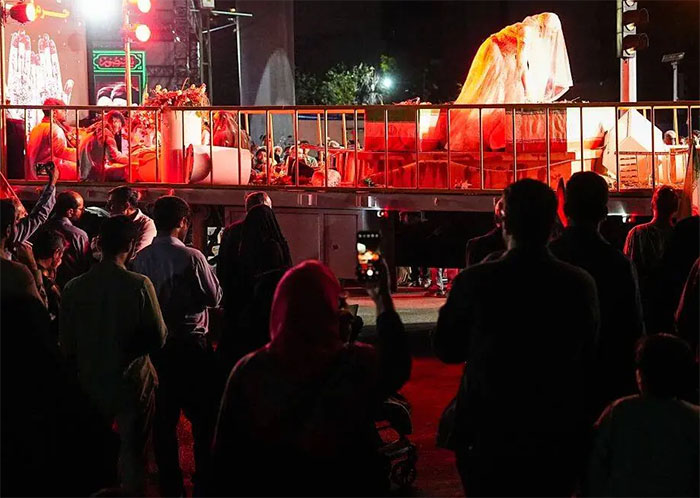
The wedding setting provides the visual reference. The truck makes the display conspicuous. The slogan encourages people to stop and look. The reported connection to Kohestak gives the scene its commemorative context.
Together, these elements create a display that differs from an ordinary wedding arrangement.
For readers discovering the event through online photographs, the slogan may be an important detail to include in the image caption and the article’s opening paragraphs.
It should not, however, replace an explanation of the tragedy itself. Search-friendly reporting is most useful when it tells readers what the event is, where it took place, why it matters and what is known about the incident being remembered.
October 20, 2026 | 6:14 pm