Why Did “Uncle John Napoleon” Succeed and “Souvoir” Fail?
3.1 Vivid Characters in “Uncle John Napoleon”: Creating Cultural Archetypes
“Uncle John Napoleon” features characters like Uncle John, Asadollah Mirza, and others who symbolize specific social classes and mentalities. These characters are crafted with detail and humor, making them relatable and memorable.
For example, Uncle John’s conspiratorial delusions symbolize a particular segment of Iranian society—those blaming foreign powers but unwilling to accept responsibility—making him a cultural archetype. Such characters help embed the work in the collective memory.
3.2 Symbolic and Less Relatable Characters in “Souvoir”
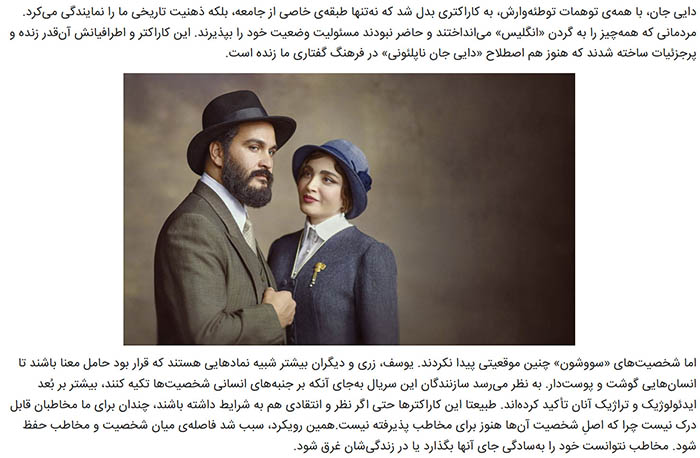
In contrast, “Souvoir” presents characters like Yousef and Zari as symbolic rather than fleshed-out individuals. Their ideological and tragic dimensions serve a narrative purpose but lack the human warmth needed for deep audience engagement.
This symbolic approach, while thematically rich, can create emotional distance, reducing viewers’ ability to see themselves in the characters and diminishing the work’s long-term cultural impact.
Section 4: Cultural Resonance and Social Critique
4.1 Humor as a Vehicle for Social Critique
“Uncle John Napoleon” masterfully uses humor and satire to critique colonialism, political hypocrisy, and societal mentalities. Its language and comedic style reflect the cultural realities of Iranian society, making its critique both sharp and approachable.
This approach allows viewers to reflect on their society while laughing, fostering a sense of shared understanding and resilience.
4.2 Heavy Tragedy and Metaphors in “Souvoir”
“Souvoir” emphasizes metaphors, tragic symbolism, and resistance myths. While these elements deepen artistic expression, they can also obscure clarity, making it harder for the average viewer to connect emotionally or understand the underlying messages.
This heaviness, coupled with a symbolic narrative structure, often results in distancing the audience—hindering the work’s ability to become a lasting part of popular culture.
August 22, 2025 | 5:57 pmMore stories
Kylie Jenner Makes Victoria’s Secret Fashion Show Debut in $50 Million Fantasy Bra
Introduction Babak Takhti is an Iranian writer, publisher and the only son of Gholamreza Takhti, the legendary Iranian freestyle wrestler … Continue reading ➝

Who Is Babak Takhti? Gholamreza Takhti’s Only Son, His Family, Career, and His Father’s Controversial Death
Introduction Babak Takhti is an Iranian writer, publisher and the only son of Gholamreza Takhti, the legendary Iranian freestyle wrestler … Continue reading ➝
Azita Hajian, Mehraveh Sharifinia and Melika Sharifinia Attend Cafe Soltan Private Screening at Megamall Cinema
Introduction The private screening of Cafe Soltan, the Iranian feature film directed by Mostafa Razagh-Karimi and produced by Morteza Razagh-Karimi, … Continue reading ➝

Bot (Bet) Movie: Hamid Nematollah’s Drama Holds Private Screening at Galleria Cinema Complex
Introduction The Iranian social drama Bot, also transliterated as Bet and associated with the English title Idol, has attracted attention … Continue reading ➝
10 Fascinating Stories About Most Famous Actresses: Behind-the-Scenes Secrets From Iconic Films and TV Shows
Introduction 1. Gohar Kheirandish in Banoo: The Makeup That Could Not Hide Her Beauty Film: Banoo (The Lady) Director: Dariush … Continue reading ➝