The Golden Era of Melodramas: Exploring Love, Suffering, and Emotional Depth in Cinema
Introduction
Many Iranian girls and boys fell in love with films that celebrated love, heartbreak, and human emotion. Up until a decade ago, Iran’s cinematic landscape was dominated by melodramatic films that told stories of love, separation, and suffering with such artistry and depth that they lingered in viewers’ minds long after the credits rolled. These films weren’t just entertainment—they were the veins of Iranian cinema, shaping cultural perceptions and emotional experiences.
In this article, we explore the golden era of Iranian melodramas, analyze their themes, and reflect on how Iranian cinema has evolved from these heartfelt stories to a contemporary landscape often dominated by social realism and political narratives. We will revisit iconic romantic films, examine their impact on Iranian society, and consider whether the magic of traditional Iranian melodramas can still find its place in modern cinema.
The Rise of Iranian Melodramas: The Heartbeat of Iranian Cinema
The Golden Age of Iranian Romantic Films
Iranian cinema in the 1960s and 1970s was characterized by a profound focus on love stories, emotional depth, and social commentary. Films like “Ghoribaneh” and “Swan Song” showcased passionate performances, tragic love stories, and narratives that connected deeply with the audience’s collective soul.
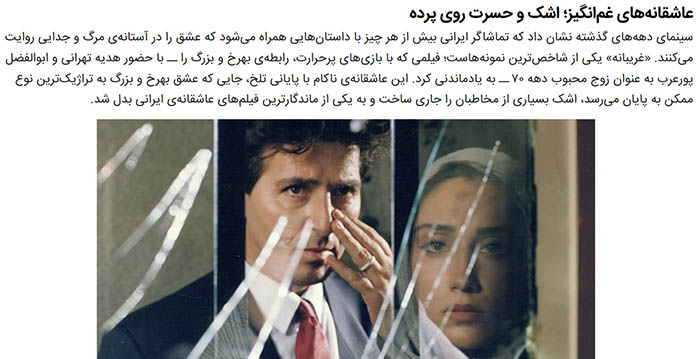
“Ghoribaneh” (1970s), featuring Hedeyeh Tehrani and Abolfazl Pour-Arab, depicted a tragic love story between Behrokh and Bozorg. It was a film that made audiences cry, showcasing love on the brink of death and separation. The film’s raw emotion and poetic storytelling made it one of the most memorable romantic Iranian films of its time.
Similarly, “Swan Song” (1980s) continued the tradition of emotional storytelling, telling the story of Peyman and Parstoo. Its controversial ending left viewers in shock, reinforcing Iranian cinema’s ability to evoke strong emotional reactions and challenge societal norms.
Why Iranian Melodramas Were So Popular
Iranian melodramas resonated with audiences because they reflected universal human experiences—love, loss, longing, betrayal, and hope. These films often portrayed love as a force that could transcend societal constraints, cultural taboos, and even death itself. The storytelling was poetic, the performances heartfelt, and the cinematography deeply expressive.