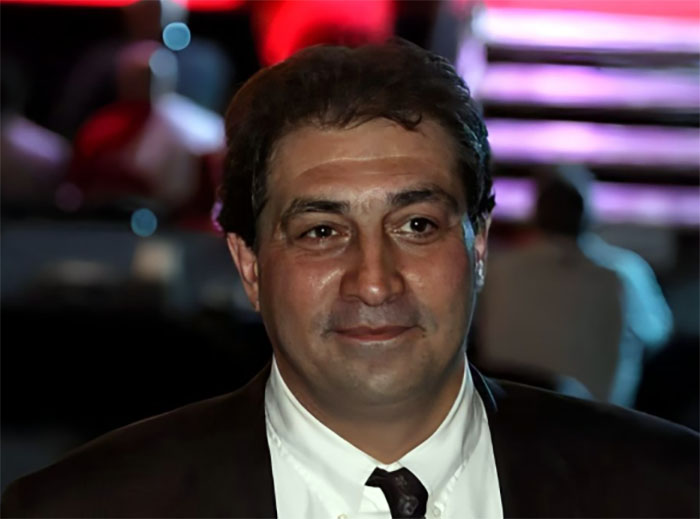
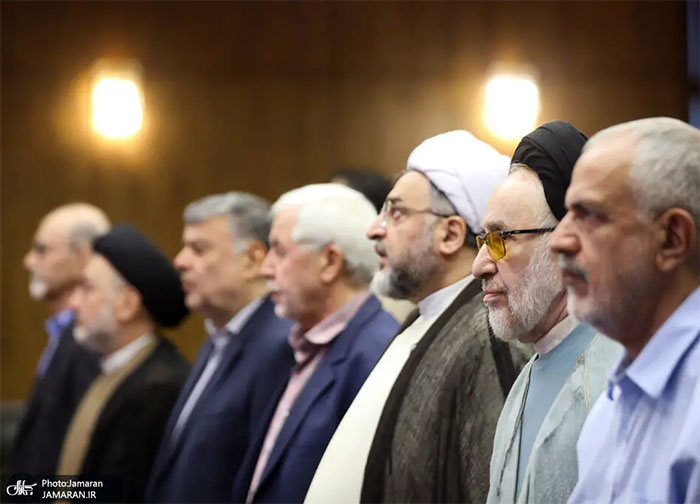
Seyyed Mohammad Khatami at the Baran Foundation Meeting
The Relationship Between Religion and Democracy
The subject of contemporary religion naturally raises another major question: Can religion and democracy coexist?
For decades, Iranian intellectuals have debated this issue from different perspectives.
Some argue that Islamic principles can provide an ethical foundation for democratic politics.
Others distinguish between religion as a source of personal morality and religion as the basis of political authority.
Still others argue that religious values and democratic institutions can coexist only when citizens are allowed to interpret their faith freely and political institutions respect individual rights.
The discussion becomes even more complicated when the state claims religious legitimacy.
In such a system, criticism of government policy can potentially be interpreted not simply as political disagreement but as a challenge to religious authority.
This is one reason the concept of religious reform in Iran remains politically sensitive.
The Baran Foundation meeting’s emphasis on contemporary man and contemporary religion can therefore be read within this larger intellectual debate.
What Does Modern Religion Mean?
The phrase modern religion can mean different things to different people.
For some, it means interpreting traditional religious teachings in a way that responds to contemporary social conditions.
For others, it means emphasizing universal ethical principles rather than detailed historical regulations.
Another interpretation focuses on distinguishing between permanent religious values and rules that were developed in response to particular historical circumstances.
This distinction is particularly important in Islamic intellectual discussions.
Islamic jurisprudence developed over centuries in societies that were structurally different from today’s world.
The modern individual lives in a political environment shaped by constitutional government, international law, scientific knowledge, digital communication, global markets and mass education.
Consequently, religious scholars who want religion to remain relevant must confront questions that earlier generations did not face in the same form.
Artificial intelligence, biotechnology, social media, genetic engineering, digital privacy, environmental crises and global migration are only a few examples.
A contemporary religious framework therefore faces a practical challenge:
How can ancient ethical traditions respond to problems that did not exist when those traditions were originally formulated?
This question is not unique to Iran. It is part of a much broader global debate about religion and modernity.
September 4, 2026 | 7:51 pm