Reza Pahlavi Speaks at 2026 Concordia Annual Summit in New York
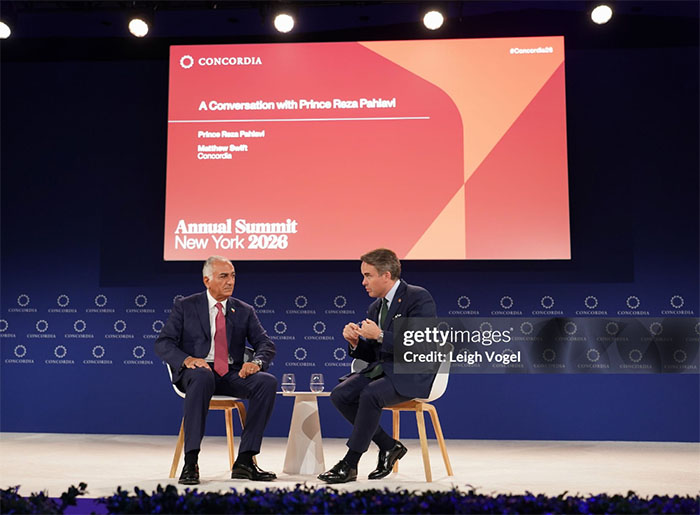
Concordia’s Focus on Democracy and Geopolitical Risk
The 2026 summit included a dedicated programming theme titled “Democracy, Security & Geopolitical Risk.” The Pahlavi conversation was placed within this category.
That classification reflects the broader nature of Concordia’s Annual Summit.
The organization positions the event as a cross-sector forum where government representatives, corporate leaders, nonprofit organizations and other international figures can discuss complex global challenges.
The summit’s programming also included sessions addressing technology, public-sector transformation, international cooperation, economic issues and global security.
This broader context is relevant because Iran is not only a domestic political issue. Developments involving Iran can have consequences for regional security, energy markets, international diplomacy and relations between Iran, the United States, European countries and neighboring states.
Consequently, discussions about Iran frequently appear in international forums that address geopolitical risk.
Reza Pahlavi and U.S.-Iran Relations
Relations between Iran and the United States have been one of the most consequential elements of Middle Eastern geopolitics for decades.
Pahlavi has consistently advocated stronger relations between a future democratic Iran and Western countries. Concordia’s description of his position specifically mentions a future Iran being friendly toward the United States and other democracies.
His position contrasts with the longstanding adversarial relationship between the Islamic Republic and the U.S. government.
Debates over Iran-U.S. relations include nuclear policy, sanctions, regional security, human rights, military activity, diplomatic engagement and the future of Iran’s government.
The Concordia conversation placed these questions in the context of political transition and international diplomacy.
It is important to distinguish Pahlavi’s political proposals from official policy adopted by the U.S. government or other governments. Participation in an international conference does not itself establish government endorsement of a speaker’s political position.
Concordia also explicitly states that participation in the 2026 Annual Summit does not imply engagement with other participants or the expression of an opinion by partners, sponsors or participants concerning specific topics.
Reza Pahlavi and the Global Iranian Community
The Iranian diaspora remains an important audience for Pahlavi.
His family name carries historical significance because of the Pahlavi monarchy that preceded the Islamic Republic.
For some Iranians outside the country, the Pahlavi era is associated with modernization and secular government. Others emphasize the political repression and authoritarian features of the monarchy.
These competing historical interpretations remain part of the Iranian political debate.
Pahlavi’s contemporary political message generally focuses more on the future than on restoring the political system of the past. His emphasis on secular democracy and national unity is intended to appeal to a broader political constituency.
The Concordia event gave him another opportunity to communicate that message internationally.
The Question of National Sovereignty
Iran’s political future also involves the question of national sovereignty.
Pahlavi has repeatedly framed political change as something that should ultimately be determined by Iranians themselves.
That distinction matters in international discussions because foreign intervention in Iran is highly controversial.
Debates over sanctions, military action, diplomatic pressure and international support for opposition groups involve competing arguments about sovereignty, human rights and regional security.
At Concordia, the discussion connected these questions to Pahlavi’s broader proposal for political transition.
His views on the role of foreign governments and international organizations form part of a larger debate about how external actors should respond to political crises in other countries.