Margaret Qualley Wears Chanel’s Viral Barefoot Shoes at The Dog Stars London Premiere
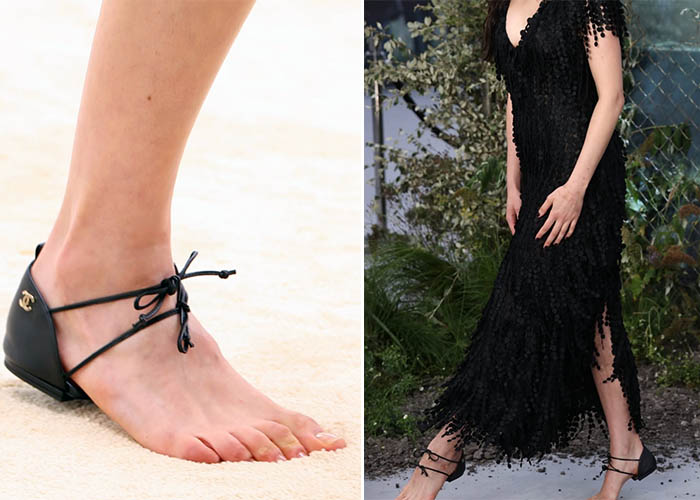
Matthieu Blazy’s Chanel Barefoot Heel
The Chanel barefoot shoe comes from Matthieu Blazy, who became Chanel’s creative director in 2025 and has increasingly used the house’s historic codes as a starting point for experimentation.
Rather than abandoning Chanel’s heritage, Blazy has been testing how far those codes can be transformed without losing their identity. The barefoot shoe is perhaps one of the clearest examples of this approach.
The classic Chanel shoe is already strongly associated with recognizable design language. The house’s cap-toe footwear, for example, has been one of its enduring signatures. Gabrielle Chanel introduced the famous cap-toe style in the 1950s, and the silhouette has continued to be reinterpreted across generations.
Blazy effectively turns that history inside out.
Instead of emphasizing the front of the shoe, he removes it almost entirely.
Instead of hiding the foot, he exposes it.
Instead of making the shoe look substantial and protective, he makes it look almost imaginary.
This radical reduction is what gives the Chanel barefoot shoe its visual power.
Chanel Resort 2027: The Biarritz Collection
The barefoot shoes were first presented during Chanel’s Resort 2027 collection in Biarritz, France, on April 28, 2026.
The location was important.
Biarritz has a direct historical connection to Gabrielle Chanel. Chanel established her first couture house in Biarritz in 1915, making the French seaside town an especially meaningful setting for Blazy’s first Chanel resort collection.
The collection drew heavily on the atmosphere of the Basque coast.
There were shimmering fish-scale effects, mermaid-inspired details, oversized accessories, swimwear references, beach-ready pieces and jewelry that echoed shells and marine life. The show also included traditional Chanel footwear, meaning that the barefoot shoe was not the only direction presented by Blazy.
But it was unquestionably the design that captured the internet’s attention.
The models appeared almost barefoot, with tiny heel structures attached to their feet by delicate straps. From a distance, the shoes could easily be mistaken for jewelry or even simple ribbons tied around the ankles.
The effect was intentionally strange.
Fashion audiences were immediately divided between those who admired the concept and those who wondered how anyone could realistically wear the shoes outside a controlled runway environment.
Why Chanel’s Barefoot Shoes Went Viral
Fashion has always been fascinated by footwear that challenges conventional ideas about what a shoe should be.
From towering platform shoes to split-toe boots, transparent heels and barely-there sandals, designers regularly question the relationship between the foot and the shoe.
But Chanel’s barefoot heel takes that idea much further.
A conventional shoe has several obvious functions. It protects the foot, separates it from the ground, provides support and contributes to the overall appearance of an outfit.
The Chanel design deliberately removes many of those visual functions.
There is almost nothing between the viewer and the wearer’s foot.
That creates an immediate visual contradiction.
The shoe is expensive, luxurious and unmistakably Chanel, yet it looks like the absence of a shoe.
That contradiction explains much of the online fascination.
Some fashion observers saw the design as an intelligent continuation of minimalist footwear. Others saw it as a deliberately provocative example of luxury fashion going too far.
Vogue’s discussion of the shoes reflected this divide, with editors debating whether the footwear was an exciting fashion fantasy or simply too strange for everyday life.
The design therefore became more than another runway accessory. It became a conversation about the meaning of footwear itself.