Women Receive Military Training as Janfada Volunteers Train With Weapons
Why Are Women Receiving Military Training?
There are several possible dimensions to the participation of women in the Janfada program.
The first is national preparedness.
Training civilians can provide basic knowledge that may be considered useful during emergencies or wartime.
The second is organizational mobilization.
Volunteer programs can create structured networks that allow participants to receive instructions and participate in coordinated activities.
The third is political messaging.
Images of women participating in weapons training communicate that the national defense effort is not restricted to men.
The fourth is psychological preparedness.
In a period of war, governments may attempt to reduce the sense of helplessness among civilians by providing opportunities for participation.
The fifth is ideological mobilization.
The language surrounding Janfada emphasizes sacrifice for the homeland and national defense.
These different objectives can coexist.
A participant may view the training primarily as an opportunity to help protect her community, while government institutions may view the same program as part of a broader national mobilization effort.
International observers may interpret it primarily as a political signal.
The photographs themselves cannot determine which motivation applies to every participant.
The Role of Women in National Defense
The presence of women in Iranian defense organizations is not entirely new.
Iran has long maintained women’s branches and volunteer organizations connected with broader state and paramilitary structures.
However, the intensity and visibility of the activities shown in the October 2026 photographs are notable.
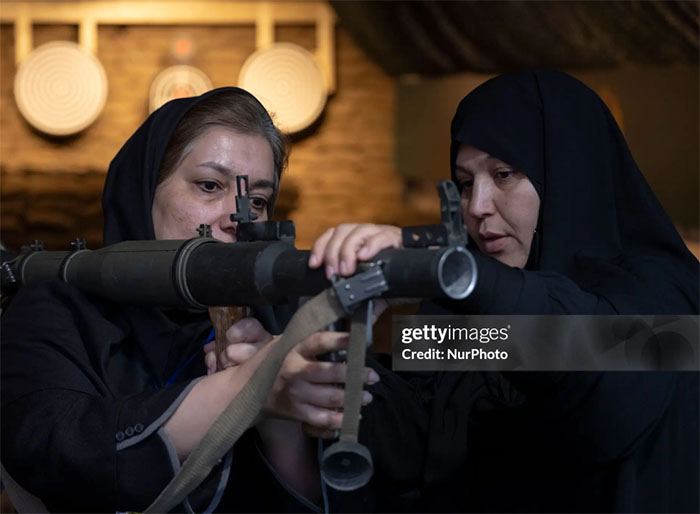
The women are photographed in an environment that resembles a conventional military training area.
They are wearing practical clothing, handling weapons and participating in exercises.
This creates a visual narrative of active participation.
The images also challenge simplistic descriptions of women in conflict.
Women can be victims of war, humanitarian actors, political activists, soldiers, volunteers, professionals, caregivers or members of state institutions.
These roles can overlap.
The Janfada photographs represent one particular form of participation: organized military preparedness.
They should therefore be viewed as part of the complex range of roles Iranian women can occupy during a period of conflict.
The Symbolism of the Rocket Launcher Photograph
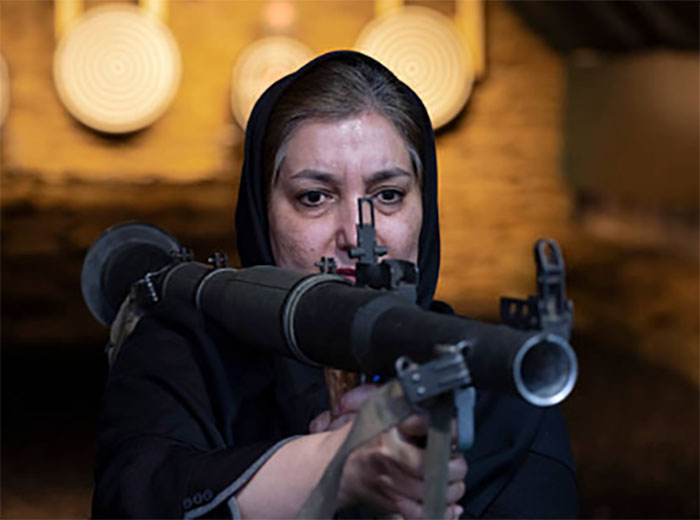
The photograph of an Iranian woman holding a rocket launcher is particularly important from a visual journalism perspective.
Photography often compresses complicated political events into a single image.
A rocket launcher immediately communicates military power.
A woman holding the weapon introduces a gender dimension.
The Tehran location introduces an urban dimension.
The civilian volunteer context introduces a national mobilization dimension.
And the timing, during an active regional conflict, introduces a wartime dimension.
Together, these elements make the photograph highly newsworthy.
The image is likely to be used in coverage discussing Iranian military preparedness, women in Iran, the Janfada campaign and the wider Iran-US confrontation.