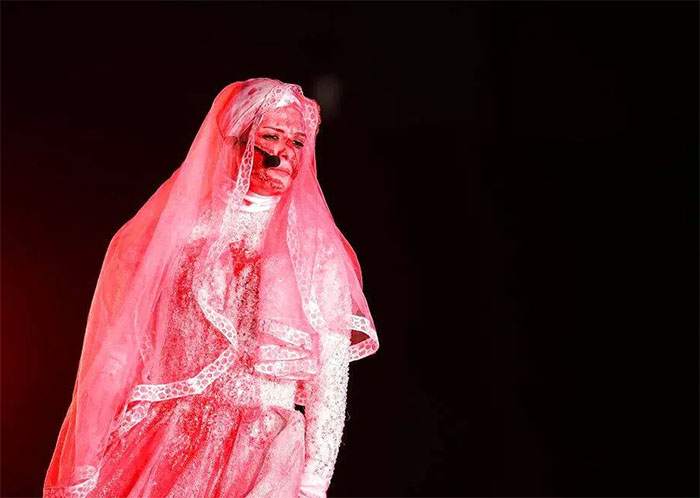
An Unusual Wedding Ceremony in Tehran Becomes a Memorial for the Victims of the Kohestak, Sirik Tragedy
The Symbolism of a Wedding in a Time of Conflict
A wedding is generally understood as a celebration of life, commitment and the beginning of a shared future. For many families, it is one of the most important social occasions they will organize. The event brings relatives together, creates lasting memories and offers an opportunity to celebrate relationships across generations.
When a wedding becomes associated with a deadly incident, these familiar meanings can change dramatically.
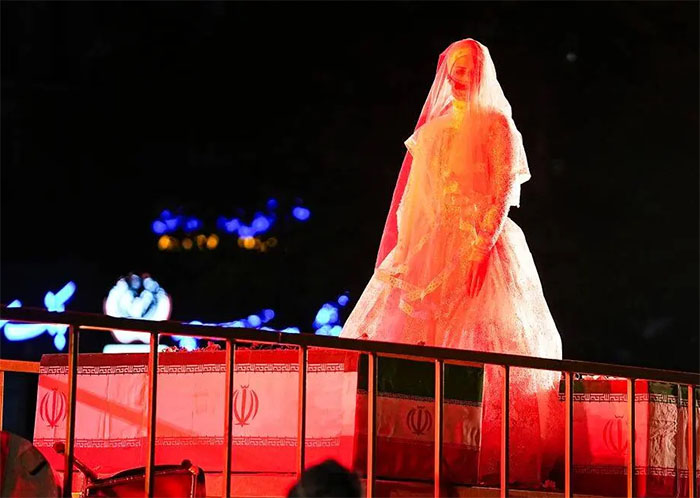
The unusual wedding-themed installation in Tehran draws attention to this contrast. Its decorations recall the visual language of a celebration, while its reported connection to the Kohestak tragedy gives the scene a more serious purpose. What might ordinarily represent happiness becomes a way to remember people affected by violence.
This contrast is not unique to Iran. Around the world, communities have used flowers, photographs, candles, clothing and objects associated with everyday life to commemorate people who died unexpectedly. Such memorials can communicate grief without requiring extensive written explanations.
The Tehran display uses wedding imagery in a similar way. It connects the visual identity of a celebration with the memory of a celebration that reportedly ended in tragedy.
The choice of a semi-trailer truck adds another dimension. A wedding venue is usually associated with a designated place, such as a hall, home or garden. A truck, by contrast, belongs to the world of transportation and commerce. Transforming it into a wedding-themed display creates an unexpected combination of ordinary and ceremonial objects.
The result is a public installation that can attract attention before viewers understand its full context.
Once the connection to Kohestak becomes clear, however, the meaning of the display changes. The visual arrangement is no longer simply an unusual street scene. It becomes part of a wider conversation about remembrance, civilian suffering and the consequences of armed conflict.
This is why the event is best understood through both its visual presentation and its reported purpose.
The Role of Public Art in Remembering Civilian Victims
Public art can take many forms, including sculptures, temporary installations, murals, performances and displays placed in unexpected locations. Some works are created primarily for aesthetic reasons, while others seek to communicate a social, cultural or political message.
A temporary memorial occupies a distinctive position within this broad category. Its purpose is not necessarily to provide a permanent monument. Instead, it creates a moment of public attention around a person, a community or an event.
The Tehran wedding display can be examined through this perspective without assuming that its organizers formally classified it as a work of art.
Its unusual arrangement invites people to consider the relationship between visual design and public communication. The semi-trailer acts as a platform, the wedding decorations establish the theme, and the slogan provides a direct invitation to look.
Together, these elements create a visual message in a setting where people would not normally expect to encounter a wedding-themed installation.
Temporary displays can also change the way people experience familiar streets. A location used every day for commuting, shopping or transportation can become a place associated with remembrance, even if only for a limited period.
Such interventions are particularly relevant to contemporary visual culture, where photographs can preserve a temporary installation long after it has disappeared.
The physical display may be short-lived, but images of it can continue to circulate online. They can introduce the event to people who were not present and provide a record for later reporting.
For journalists, this creates an opportunity to document both the installation itself and the message it communicates.
The distinction between documentation and interpretation remains important. A photograph can show how the display was arranged, but the reasons for particular design choices should be attributed to organizers or supporting sources when that information is available.
In the Tehran case, the reported memorial connection provides the clearest basis for understanding the installation.
October 20, 2026 | 6:14 pm