A Tour of Persia: Rare 1969 GQ Photos Show American Models Exploring, Fashion and Life
Final Thoughts
The 1969 GQ “A Tour of Iran” photographs are a fascinating reminder that Iran’s visual history is much broader than the images that dominate contemporary discussions of the country.
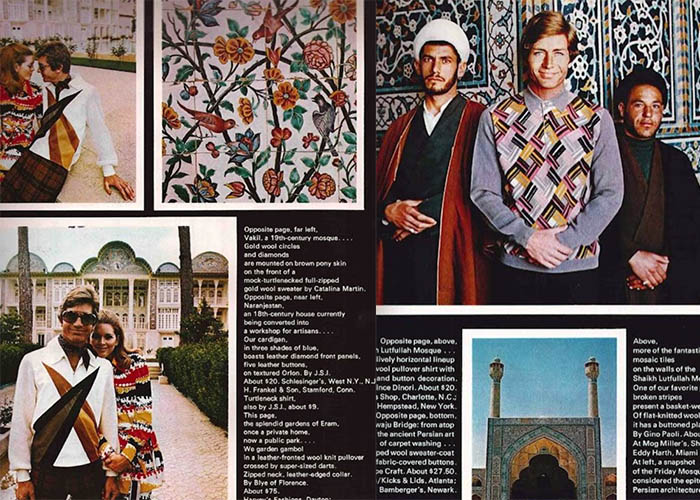
In these photographs, Iran appears through the lens of international fashion.
Two American models travel through the country.
Leonardo Nuñez photographs them.
Persian gardens and historic landscapes become backdrops.
What was “A Tour of Iran” in GQ?
“A Tour of Iran” was a 1969 GQ feature combining travel and fashion photography. The feature presented two American models traveling through different parts of Iran while wearing various fashionable outfits.
Who photographed the GQ Iran feature?
The photographs are credited to Leonardo Nuñez.
When was GQ’s “A Tour of Iran” published?
The feature dates to 1969, making it a rare visual record of Iran during the late Pahlavi period.
Where were the GQ models photographed?
The models were photographed in different Iranian settings. One of the most recognizable photographs shows them in Eram Garden in Shiraz.
What is Eram Garden?
Eram Garden, known in Persian as Bagh-e Eram, is a historic Persian garden in Shiraz. It is famous for its landscaped grounds, water features and historic architecture.
What did the models wear in the 1969 Iran photographs?
The models wore international fashion garments associated with brands including Catalina Martin, GSI and Blye of Florence, with clothing information and prices accompanying the photographs.
Was Iran fashionable in the 1960s?
Iran’s major cities, particularly Tehran, were increasingly connected to international fashion and consumer culture during the 1960s. However, Iranian clothing varied greatly according to region, community, occupation and social background, so a fashion magazine photo essay should not be treated as representative of all Iranian dress.
What was Iran like in 1969?
Iran in 1969 was under the rule of Mohammad Reza Shah Pahlavi. The country was experiencing rapid modernization, urbanization and industrial development while retaining extensive historical and cultural traditions.
Was 1969 Iran before the Iranian Revolution?
Yes. The Iranian Revolution occurred in 1979, approximately ten years after the GQ feature.
Why are photographs of pre-revolutionary Iran important?
They provide visual evidence of Iranian cities, architecture, fashion, consumer culture and international connections before the political transformation of 1979.
Why are the GQ 1969 Iran photographs interesting today?
They combine fashion history, Iranian cultural history, travel photography, architecture and consumer history. They also document how an American magazine presented Iran to Western readers during the late 1960s.
Do the photographs represent everyday Iranian life?
Not completely. They were created for a fashion magazine and therefore represent a carefully selected editorial perspective. They should be understood as fashion and travel photography rather than a comprehensive documentary record of Iranian society.
What makes Shiraz important in the photographs?
Shiraz was and remains one of Iran’s major cultural cities. It is associated with Persian poetry, historic gardens and the wider heritage of Fars Province. Its proximity to major ancient Persian sites also makes it an important destination for international visitors.
Why was Iran an interesting location for fashion photography?
Iran offered a unique combination of ancient architecture, Persian gardens, historic cities, modern urban environments and distinctive landscapes. These settings created strong visual contrasts with contemporary Western fashion.
What do the clothing prices tell us?
The prices provide historical information about fashion and consumer culture in 1969. They can also be used as starting points for research into the cost of clothing and purchasing power during the period.