A Tour of Persia: Rare 1969 GQ Photos Show American Models Exploring, Fashion and Life
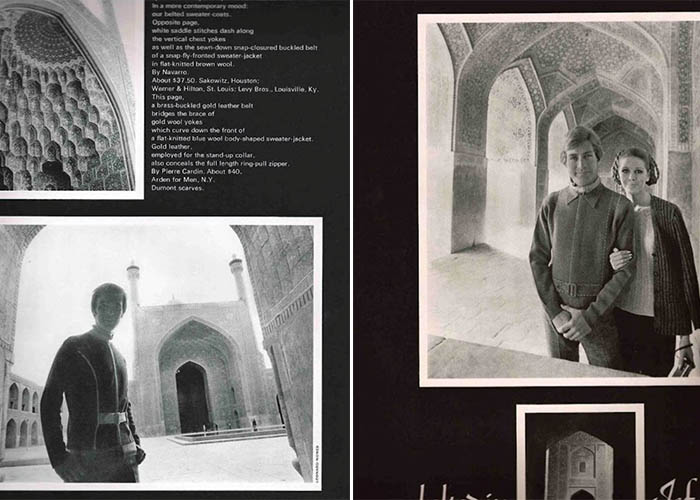
The Western View of Iran in the 1960s
The relationship between Iran and the United States was significantly different in 1969 from what it would become after 1979.
Iran was an important American partner in the Middle East.
The Shah’s government maintained close relations with Washington, and American businesses had extensive interests in the country.
This geopolitical relationship formed part of the broader background against which American magazines presented Iran to their readers.
But politics was not necessarily the subject of a fashion story.
Instead, Iran could be presented as an exotic destination filled with history, architecture and visual beauty.
This is one reason the GQ 1969 Iran feature is historically interesting.
It represents the country through lifestyle and fashion rather than through political reporting.
Iran Travel Before Mass Tourism
Travel to Iran in the 1960s was very different from travel today.
International tourism was much smaller.
Air travel was expensive compared with modern standards.
Travel information was largely obtained from printed guidebooks, magazines, newspapers and personal recommendations.
A feature in a major publication could therefore have a powerful influence on how readers imagined a destination.
For an American reader in 1969, photographs of Tehran, Shiraz or Persian gardens might have been among the few visual encounters with Iran available outside books and television.
The magazine could effectively function as a travel guide.
The models demonstrate what a traveler might see.
The fashion demonstrates what a stylish traveler might wear.
The locations demonstrate where one might go.
The combination is essentially a form of 1960s travel marketing through editorial photography.
Why Vintage GQ Iran Photos Matter Today
More than half a century later, photographs from “A Tour of Iran” have acquired a new significance.
The images are now historical documents.
They show a country that no longer exists in exactly the same political and cultural form.
They also demonstrate how international fashion media represented Iran before the 1979 revolution.
For younger generations, photographs of Iran from the 1960s can be surprising because they challenge simplistic assumptions about the country’s recent history.
The photographs show fashionable Western clothing, modern architecture, international travel and a society participating in global consumer culture.
At the same time, Persian cultural heritage remains highly visible.
That coexistence is one of the most important themes in the photographs.
September 20, 2026 | 6:27 pm