9 Famous Celebrity Love Stories That Captivated the World
3. Forough Farrokhzad and Nader Naderpour: Poetry, Desire, and a Complicated Literary History
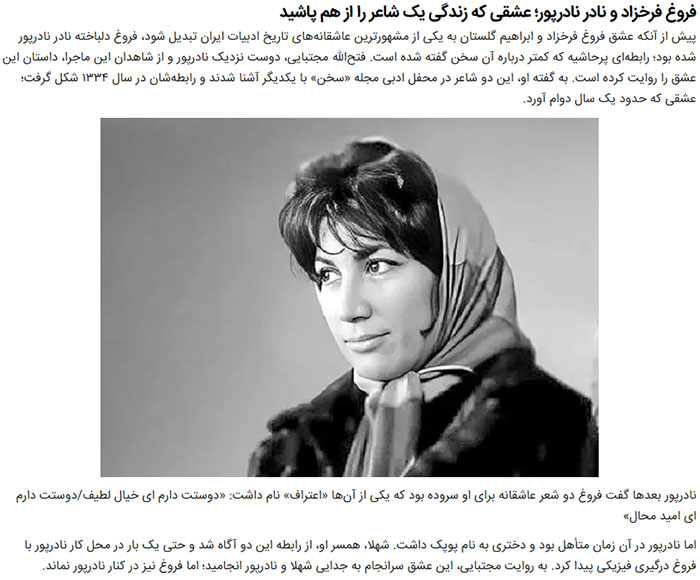
Forough Farrokhzad is one of the most influential poets in modern Persian literature. Her writing challenged established expectations about women’s voices, desire, identity, and artistic independence.
Her poetry remains widely read because it combines emotional directness with a distinctive exploration of personal freedom and social constraint.
Her life has also attracted sustained interest from biographers, literary historians, and readers fascinated by the connections between her personal experiences and her work.
Among the stories associated with her early life is a reported relationship with fellow poet Nader Naderpour, which is discussed in accounts attributed to individuals familiar with Tehran’s literary circles during the 1950s.
Because this narrative involves private relationships and retrospective testimony, it is important to distinguish what particular witnesses have claimed from what can be independently established.
Who Was Forough Farrokhzad?
Born in Tehran in 1934, Forough Farrokhzad became a major voice in twentieth-century Persian poetry.
Her early collections attracted attention for their direct treatment of love, loneliness, desire, and the limitations placed on women by social conventions.
At a time when public discussions of women’s sexuality and personal autonomy were often constrained by conservative expectations, her poetry was notable for speaking openly from a woman’s perspective.
Farrokhzad’s writing developed considerably throughout her career. Her later work became increasingly complex in its philosophical concerns, imagery, and reflections on human existence.
She also worked in filmmaking. Her documentary The House Is Black, released in 1962, examined life in a leprosy colony and is widely recognized as an important work in Iranian documentary cinema.
Her artistic legacy extends beyond poetry because she helped expand the possibilities of both literary expression and visual storytelling.
Nader Naderpour and Tehran’s Literary Circles
Nader Naderpour was an influential Persian-language poet whose work formed part of the broader modernist movement in Iranian literature.
During the mid-twentieth century, literary magazines and intellectual gatherings provided spaces where writers, poets, translators, and critics exchanged ideas.
The magazine Sokhan was one of the important publications associated with Iran’s literary culture during this period.
Such circles created opportunities for artistic collaboration and intellectual debate. They also brought together people whose personal lives could become intertwined with their professional relationships.
Accounts attributed to literary figure Fathollah Mojtabai describe Farrokhzad and Naderpour meeting within this environment and becoming romantically involved around 1955.
This account has contributed to discussions about Farrokhzad’s early relationships, although it should not be treated as a complete or definitive record of every aspect of their private lives.
The Reported Relationship Between Two Poets
According to the account attributed to Mojtabai, the relationship lasted approximately a year.
The story is often discussed in connection with Farrokhzad’s early poetry and the intensity with which she approached emotional experience.
However, interpreting a poet’s writing as a direct diary of romantic events can be misleading. Poetry transforms experience through metaphor, structure, imagery, and artistic invention.
Even when a poem is inspired by a real person, its meaning is not limited to a literal description of that relationship.
Farrokhzad’s work is particularly important because it moves between intimate emotion and broader questions about freedom, identity, social expectations, and the human condition.
A romantic relationship may form part of a biographical discussion, but it cannot fully explain the literary achievement of either poet.
“E’teraf” and the Interpretation of Love Poetry
Some accounts of the reported relationship refer to two poems that Farrokhzad allegedly wrote for Naderpour, including one identified as “E’teraf,” or “Confession.”
A line frequently reproduced in English-language accounts expresses love for a delicate vision and an impossible hope.
The wording and translation should be checked against a reliable Persian-language edition before being quoted as an exact literary text.
Translation is especially important in Persian poetry because words may carry layers of cultural, emotional, and historical meaning that are difficult to reproduce in English.
A single line can also be circulated without its original context, encouraging readers to interpret it as a direct declaration to a particular person.
For literary historians, the more useful question is how Farrokhzad developed a poetic voice capable of articulating desire, vulnerability, and independence within a society undergoing significant cultural change.
The Reported Marriage Complications
Accounts of the relationship describe Naderpour as married at the time and mention that his wife, identified as Shahla, learned of the reported affair.
The same narrative describes a confrontation between Shahla and Farrokhzad and suggests that the situation contributed to the breakdown of the marriage.
These are serious personal claims and should be presented only with clear attribution to the original testimony. Without corroborating evidence, they should not be treated as an independently established account of events.
The story has nevertheless become part of the biographical narrative surrounding Farrokhzad’s early life.
It illustrates how the private lives of writers can become subjects of intense scrutiny, especially when their literary work challenges social norms.
It also highlights a problem common in celebrity and literary biography: the temptation to explain a person’s art primarily through intimate relationships.
Farrokhzad’s poetry deserves to be understood on its own terms, rather than reduced to a sequence of romantic experiences.
Forough Farrokhzad and Ebrahim Golestan
Farrokhzad’s relationship with filmmaker and writer Ebrahim Golestan is much more widely discussed in biographies and literary commentary.
Their personal and artistic connection has been examined in relation to Farrokhzad’s later creative development, particularly her work in film and her growing intellectual independence.
Golestan was an important figure in Iranian cultural life, known for his writing, filmmaking, and role in modern Iranian cinema.
Their relationship remains significant to discussions of Farrokhzad’s biography, although interpretations of how it influenced specific poems or films vary.
The continuing interest in their connection reflects the broader fascination with the meeting of poetry and cinema in twentieth-century Iran.
It also demonstrates why biographies must distinguish between documented collaborations, direct personal testimony, and later interpretations of artistic influence.
Why Farrokhzad’s Romantic Life Continues to Attract Readers
Searches for Forough Farrokhzad’s love life often reflect a desire to understand the person behind the poetry.
Readers want to know how her experiences related to her treatment of desire, loneliness, marriage, independence, and social restrictions.
Yet her enduring significance lies in more than any particular romance. She transformed the language through which women could express personal experience in Persian poetry.
Her work continues to speak to readers because it addresses questions that remain relevant across generations: How can an individual live authentically? What happens when personal desires conflict with social expectations? How can art express experiences that are difficult to discuss openly?
The reported relationship with Naderpour belongs to a wider biographical discussion, but it should not overshadow Farrokhzad’s artistic achievement.
October 16, 2026 | 6:36 pm