Babak Zanjani’s Luxury Pastry Cafe Opens in West Tehran; Reactions to a Remarkable Return
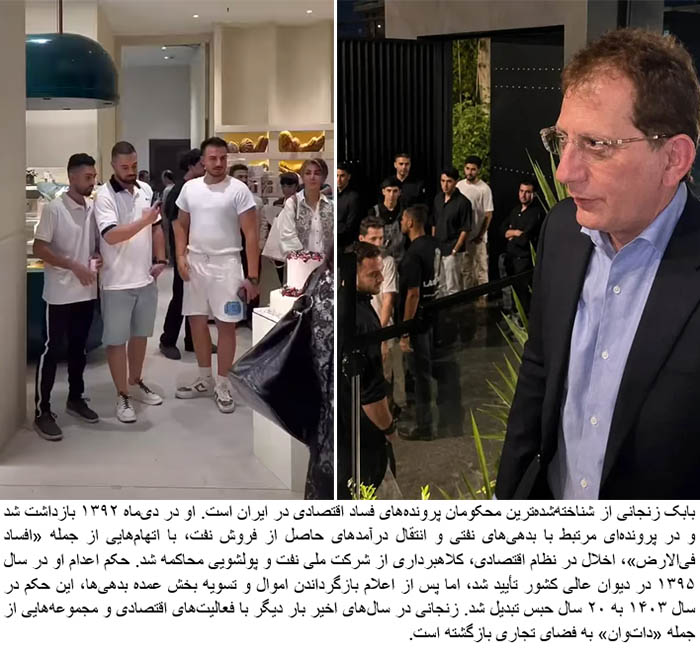
Why Is Babak Zanjani’s Cafe Getting So Much Attention?
The simplest answer is that Babak Zanjani is not an ordinary businessman in the eyes of the Iranian public.
His name became internationally known after his arrest in 2013 and the subsequent prosecution over billions of dollars connected to Iranian oil revenues. He was eventually sentenced to death in 2016. The sentence was later commuted to 20 years in prison in 2024 after Iranian authorities said he had cooperated in returning assets and settling the government’s claims.
That history means that every new commercial project associated with Zanjani naturally attracts questions.
Why is he back in business?
How was his sentence changed?
What happened to his assets?
What companies is he currently associated with?
What is DotOne?
What happened to Sorinet?
What is the connection between Babak Zanjani and cryptocurrency?
And now, what is Sourinette VIP?
These questions have made the new cafe opening considerably more newsworthy than an ordinary bakery launch.
Recent reports have specifically described the cafe as a new commercial activity attributed to or associated with Zanjani, rather than presenting independently verified corporate documentation establishing every aspect of its ownership. That distinction is important when discussing a businessman whose commercial history has been the subject of extensive legal and political controversy.
Who Is Babak Zanjani?
Babak Zanjani is an Iranian businessman whose rise and fall became one of the most closely watched financial stories in Iran.
Born in Tehran in 1974, Zanjani built a large business network before becoming involved in one of Iran’s most prominent oil-revenue cases. He became associated with the Sorinet Group, a conglomerate whose activities extended across sectors including finance, hospitality, aviation, information technology, real estate and infrastructure.
His international profile grew substantially during the period when Iran faced extensive international sanctions. Zanjani became known as an intermediary involved in moving money associated with Iranian oil sales under difficult sanctions conditions.
The scale of the financial allegations was enormous.
Iranian authorities accused him of withholding billions of dollars owed to the state. Different reports have cited different figures depending on the stage of the case and the accounting used, but approximately $2.7 billion became one of the most frequently cited figures associated with the government’s claims.
The case ultimately became a symbol of the complicated financial environment created by international sanctions, restricted banking channels, oil exports, offshore companies and informal financial networks.
Zanjani’s defenders and critics have offered different interpretations of his activities, but the legal outcome was clear: he was convicted and sentenced to death.
That makes his later return to public commercial activity particularly striking.
August 23, 2026 | 8:58 pm