Seyyed Mohammad Khatami at the Baran Foundation Meeting
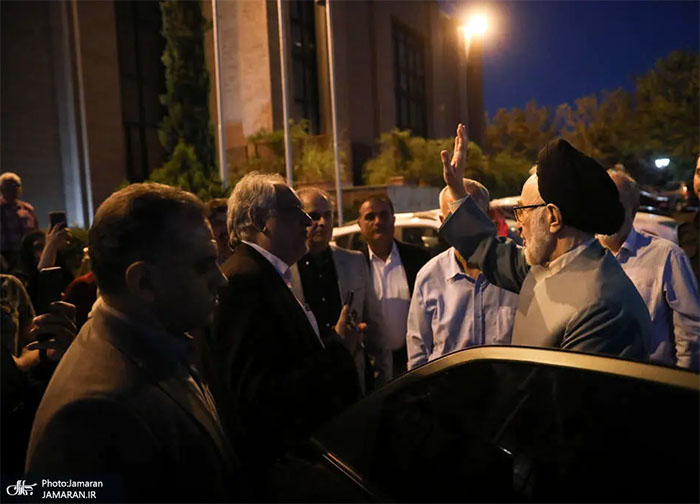
Seyyed Mohammad Khatami, Iran’s former president and one of the most recognizable figures associated with the country’s reformist political tradition, appeared at the 146th specialized meeting of the Baran Foundation, where the central theme was the relationship between the contemporary individual and religion.
The meeting, held at the Great Islamic Encyclopedia’s Raizan Conference Center, brought together Khatami and religious scholar Hadi Soroush for a discussion centered on the subject of “Contemporary Man and Contemporary Religion.” Recent reports from Iranian media described the event as the 146th specialized session organized by the Baran Foundation, also known as the Foundation for Freedom, Growth and Development of Iran.
The appearance of Mohammad Khatami at the event immediately attracted attention because of his continuing importance in discussions about Iranian politics, reformism, civil society, political participation, religion, democracy and the relationship between traditional religious interpretations and the demands of modern society.
Although Khatami has been away from the presidency for many years, his name remains closely connected with one of the most important political periods in modern Iranian history. His presidency from 1997 to 2005 was associated with the reform movement, the expansion of civil society discourse, greater emphasis on freedom of expression and attempts to redefine the relationship between state institutions, citizens and political participation.
The latest Baran Foundation meeting therefore has significance beyond the photographs from the event. The subject itself — contemporary man and contemporary religion — touches upon some of the most persistent questions in Iranian intellectual and political life: How should religion respond to a changing society? What rights should the modern individual possess? How can religious values coexist with freedom, pluralism and human dignity? And what happens when traditional interpretations of religion encounter a generation whose expectations, education, technology and social experiences are fundamentally different from those of previous generations?
September 4, 2026 | 7:51 pm